
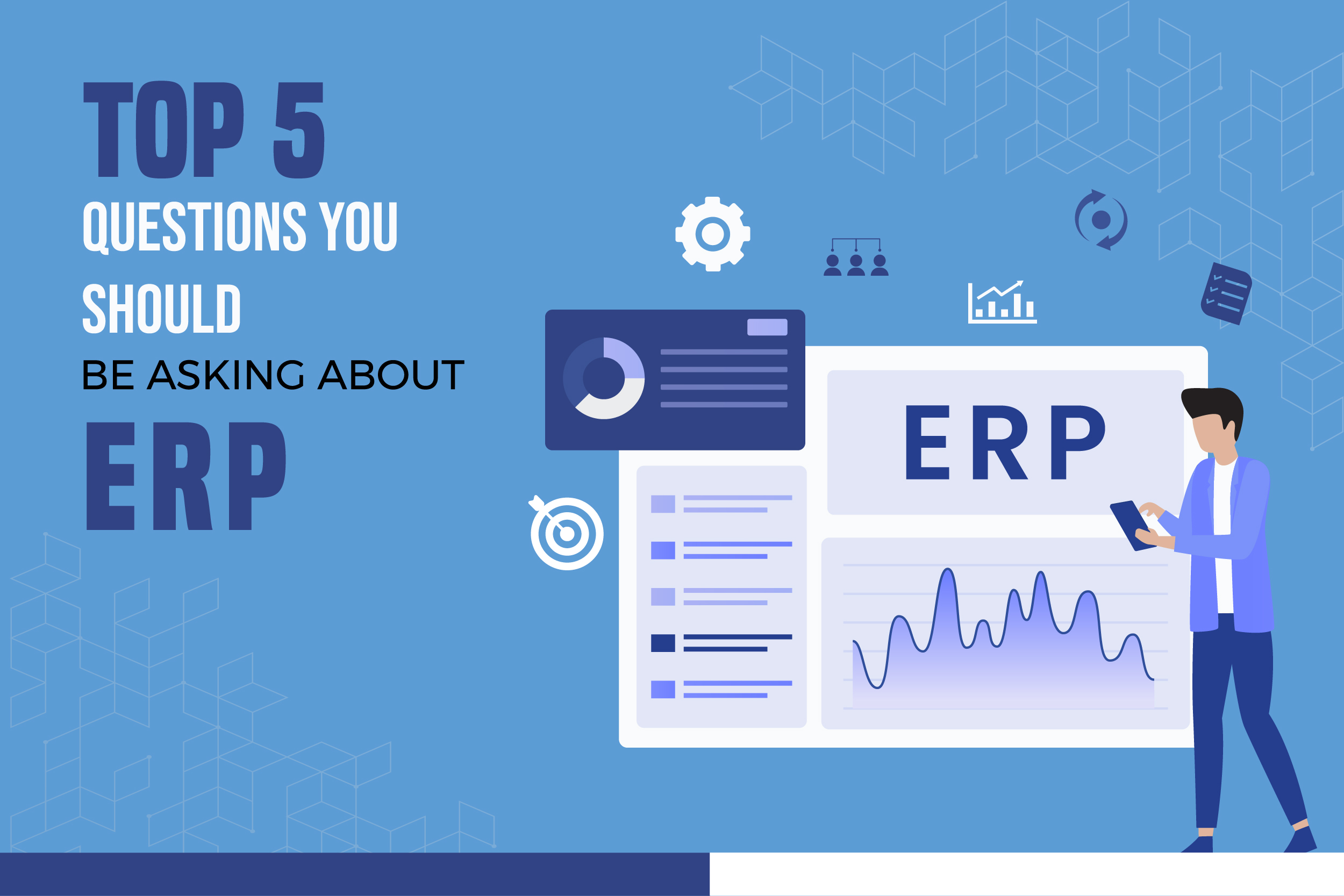
Before starting to use any ERP Implementation every business must answer these 5 questions.
All large firms and many smaller ones use enterprise resource planning (ERP) software. ERP implementation however is complex and frequently perplexing for firms that are approaching it for the first time. It’s not as complex as rocket science but understanding and implementing ERP in your business is going to be messy and difficult and an SAP consulting service provider can help you to smoothen the process and make it easy for you to use ERP.
Depending on the objectives and requirements of the organization, ERP assists in managing, integrating, and organizing all data and business activities, including ordering, production, finance, procurement, human resources, distribution, and supply chain. When properly integrated, the programme analyzes, standardizes, and streamlines data as a unified platform.
Due to the price of software, implementation, and computer systems, traditional ERP often requires a substantial investment. Deployment can take a while as well because it needs to be customized for different business sector needs and change management. This profile works well for larger companies with complicated, high-volume industries.
Due to the fact that the system is housed on the safe infrastructure of an outside service provider, cloud ERP makes ERP more accessible to SMEs. Businesses have browser-based access to data and functionality without having to invest in hardware, which is ideal for the modern hybrid workplace.
Cloud installations can be implemented faster than conventional solutions and are easier to use without sacrificing key functionality. In most instances, they provide the same fully functional, internationally accessible ERP solutions as their on-premise counterparts. A cloud-based ERP project may have a higher chance of success than a traditional large ERP project due to simpler, quicker deployment and less requirement for customization.
Cloud-based ERP is advantageous for virtually every business that handles sales and accounting for its goods and services, along with managing people, processes, products, or services. ERP is an integrated software platform that manages all of these fundamental tasks with configurations tailored to particular industries to address issues unique to your company.
When a company has more than 10 workers and at least $1 million in yearly revenue, it should start to think about using a cloud-based ERP system. This is an option for medium-sized and even large businesses as opposed to implementing standard ERP systems, which are expensive, rigid, and frequently plagued by unsuccessful ERP Solutions.
You can get away with having different platforms for your accounting, inventory, and sales ordering if your company is really tiny and has few employees. However, it’s time to switch to ERP when your company has to grow, add employees, conduct more transactions, and connect with external suppliers.
ERP eliminates duplicate processes and inaccuracies that result from entering the same data into many software systems, providing a single source of truth for data. By providing the real-time data required for decision-making, automated procedures in ERP promote efficiency, boost production, and lower the cost of overstock. You can use ERP to produce the forecasts required to stay one step ahead of your rivals.
ERP system prices will vary based on a number of criteria, including the size of the business, the platform, and implementation partners chosen, the level of customization, training and change management expenditures, and others. Due to the fact that each system is specifically designed for the firm utilizing it, there is no one magic number.
Cloud ERP vendors employ rigorous operational and infrastructure security controls to safeguard the underlying network, servers, and apps while limiting access to confidential company information. Business data stored in a cloud ERP is almost always safer than data stored in self-managed on-premise solutions.
Additionally, cloud ERP can be set up to accommodate compliance laws, including financial rules, data protection rules like GDPR, and FDA guidelines for life sciences corporate compliance. For backend operations, businesses in regulated industries commonly employ cloud ERP solutions. Therefore, you may rest assured that your company can as well.
The majority of ERP solutions will satisfy a business’s demands. The level of support a vendor can offer, whether there are solutions specifically designed for the company’s industry, and the availability of a partner network of support providers who can aid in the implementation, integration, and long-term support of the software all play a role in choosing the best vendor solution for a business.
In most cases, organizations won’t make a mistake if they pick one of the top three ERP providers: SAP, Netsuite, or Oracle.
Because it is the largest ERP provider and provides a variety of software solutions based on the size of the organization that can be upgraded as a company expands, SAP in particular merits consideration. SAP offers SAP Business One and SAP Business ByDesign for rapidly expanding early-stage and mid-market firms that are utilizing ERP for the first time.
SAP users can learn a lot about SAP and ERP and why they are doing what they are doing by asking the above 5 questions about ERP. And SAP consulting services can help businesses understand and align their values with the implementation of ERP in their business.
Enterprise transformation is no longer a niche service—it has become a critical driver for organizations seeking growth, agility, and resilience. Businesses today face unprecedented challenges: rapidly evolving technologies, shifting customer expectations, and complex global markets. In response, transformation consulting has evolved from offering generic recommendations to delivering highly specialized, strategic guidance that helps enterprises navigate this dynamic landscape.
Understanding how consulting is changing provides insights into what the future of enterprise transformation consulting looks like, and why companies are increasingly relying on experts to guide their transformational journeys.
Read More
Artificial intelligence is quickly moving from experimentation to real business impact. Organizations are using AI to automate decisions, improve customer experiences, and extract insights from massive volumes of data. However, simply adopting AI tools does not guarantee success. Many companies discover that their existing workflows were never designed to support intelligent automation.
To unlock the full potential of AI, businesses must rethink how their processes are structured. This is where business process transformation becomes essential. Organizations need AI-ready processes that are structured, data-driven, and adaptable. Without these foundations, even the most advanced AI systems struggle to deliver value.
Understanding how to prepare processes for AI helps businesses build systems that are not only efficient today but also capable of evolving with future technologies.
Read More
Businesses today are under constant pressure to move faster, operate efficiently, and deliver better customer experiences. In response, many organizations invest in automation tools and digital technologies. However, a common misunderstanding arises when companies assume automation alone equals transformation.
In reality, automation vs transformation is not a comparison of competing strategies. Instead, automation is a component of digital transformation, not the transformation itself. Understanding this distinction is essential for organizations that want to achieve meaningful and lasting change.
When leaders realize that automation is not digital transformation, they can approach technology adoption more strategically and avoid investing in tools that produce only limited impact.
Read More
In today’s fast-paced business landscape, uncertainty is the only constant. From global economic shifts to rapid technological change, organizations face pressures that can disrupt operations, challenge growth, and threaten survival. In this environment, organizational resilience is no longer optional—it is essential. Companies that cultivate adaptability, foresight, and responsiveness are better equipped to thrive, even under the most challenging circumstances.
How companies stay resilient begins with a mindset that sees disruption not as a threat, but as an opportunity to learn, evolve, and innovate. Resilient organizations do more than recover from setbacks—they anticipate challenges, respond effectively, and emerge stronger.
Read More
In today’s fast-paced digital landscape, businesses must adapt to changing technologies and customer expectations to remain competitive. One of the most effective ways to achieve this adaptability is through digital transformation, which involves integrating digital technologies into all areas of a business. A critical component of this transformation is Enterprise Resource Planning (ERP) systems.
Read More
Implementing an SAP system can be a transformative step for organizations aiming to enhance their operational efficiency, streamline processes, and improve data visibility. However, success in an SAP implementation goes beyond simply completing the project on time and within budget. It involves measuring and analyzing key performance metrics that provide insight into how effectively the system is being utilized and whether it meets the organization’s objectives.
Read More
In today’s fast-paced business environment, efficient systems and processes are vital for success. Enterprise Resource Planning (ERP) systems like SAP are central to this, helping organizations streamline their operations, manage resources more effectively, and drive productivity.
However, ERP implementation is a complex and often challenging process that requires a skilled IT consulting partner to ensure success. Selecting the right IT consulting services for your ERP implementation, especially for SAP, can make the difference between seamless integration and costly disruptions.
Read More
ERP systems have become indispensable tools for businesses looking to streamline operations, improve efficiency, and maintain a competitive edge. However, implementing ERP solutions can be daunting, especially for small and medium-sized businesses (SMBs) with limited resources.
The complexity of the process, cost concerns, and the need for seamless integration across departments pose significant challenges. To overcome these, SMBs must adopt tailored ERP implementation strategies that align with their unique requirements.
Read More
In today’s fast-paced business environment, Enterprise Resource Planning (ERP) systems like SAP (Systems, Applications, and Products) are crucial to streamlining operations, improving efficiency, and supporting growth. However, the process of SAP implementation can be complex and time-consuming, often putting a strain on internal resources.
This is where IT consulting services come into play, providing the necessary expertise and support to accelerate your SAP implementation timeline. By leveraging specialized knowledge and proven strategies, IT consulting services can significantly shorten the time required for successful SAP deployment, helping organizations stay competitive and responsive to market demands.
Read More
As enterprises scale, managing resources, streamlining operations, and maintaining flexibility become crucial challenges. To address these challenges, businesses increasingly turn to cloud-based Enterprise Resource Planning (ERP) systems.
ERP solutions have long been vital in centralizing various business functions like finance, human resources, supply chain management, and customer relations into a unified system. In recent years, the shift to cloud-based ERP systems has offered even greater benefits, particularly for growing enterprises.
Read More
Leave a Reply