
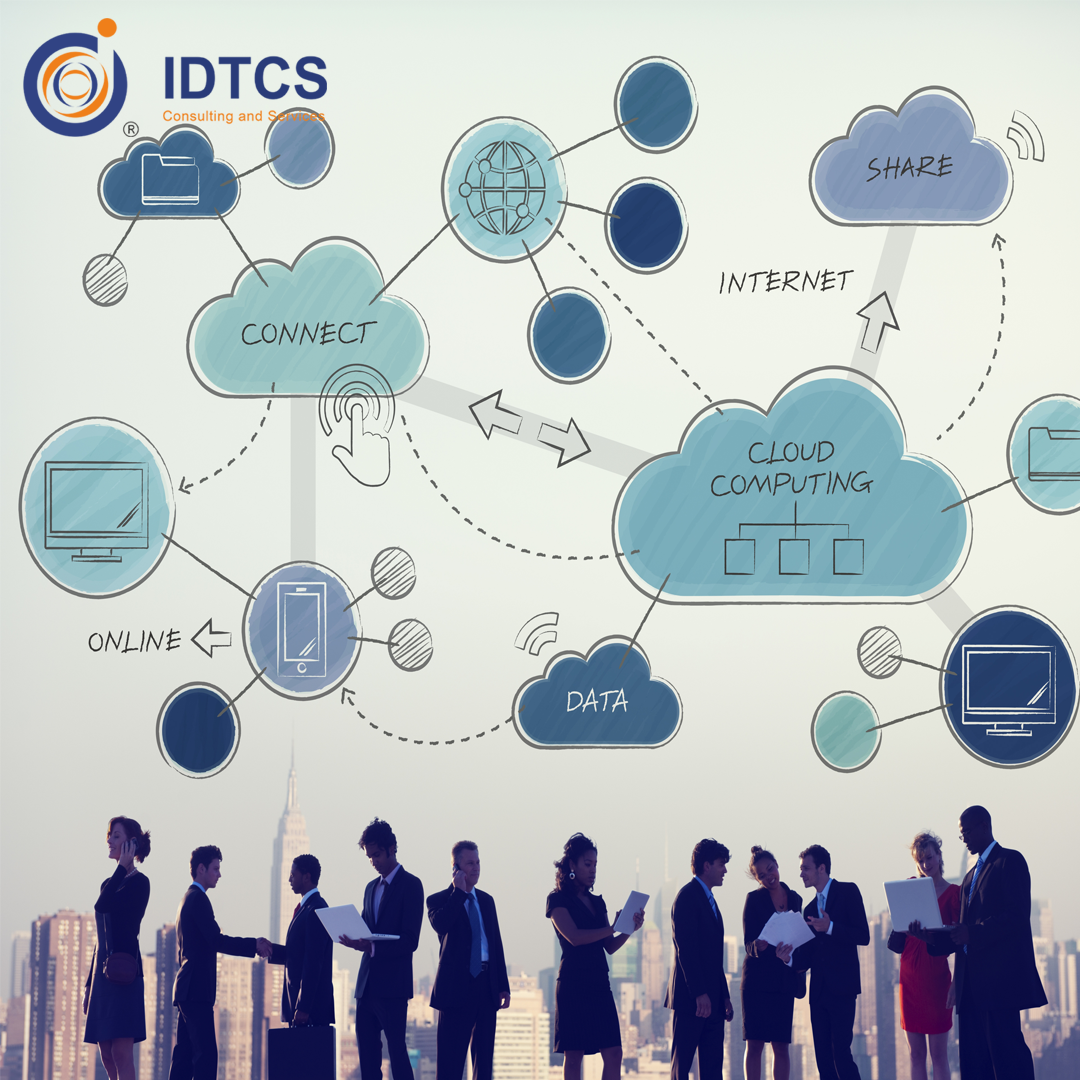
Cloud computing enables organisations to avoid managing physical servers to access files or run applications on their local devices. The cloud allows users to access all the files from any remote device.
Cloud is the internet universe that acts as a global server that stores information, data, files besides software and databases that can be operated on those servers. The cloud allows users to access all the files as well as applications from virtually any remote device. This is easily possible due to the fact that the process of computing and storage occurs on servers in a data center on the cloud and not in the user’s device locally.
Therefore cloud computing enables organisations to avoid managing physical servers of their own in order to access files or run software applications on their local devices. A clear example of this is how your email account along with the entire inbox with all conversation history, attached photos, videos, etc. travels with you and is accessible through any device wherever you go even if your phone or laptop is left at home!
This is why businesses around the world are switching to cloud computing as it offers expedient and omnipresent network access to a shared pool of vast computing resources like networks, servers software applications, services, etc. This totally removes the need for a traditional system of hard drives or private servers managed at the organization’s own premises. This model of computing curtails a huge cost on various counts for an enterprise.
Cloud computing services are usually carried out by third parties, and they only charge for a specific service availed. There is umpteen number of cloud consulting service providers who facilitate remote access of stuff stored in the cloud thereby relieving organisations of the burden of managing copies of files, databases, programs, etc. on their own local systems.
This makes the role of a cloud consultant important and attractive for the tasks they perform.
The cloud environment has revolutionised the dynamics of the IT infrastructure where business enterprises and industries have a gamut of options and choices available to them to find the cloud solutions that are best suited for their needs. Now since so many cloud transformation service providers are available in the market, choosing the best cloud consulting service with the right deployment model calls for a judicious selection for specific requirements.
Efficient cloud professionals provide guidance while effectively facilitating and implementing their customers’ package transportation to the cloud. Their services are usually packed with cloud advisory besides migration and implementation and managed service roles focused on infrastructure transformation and infrastructure managed services. The solutions provided by them to the various businesses and industries help them stay optimized, and compliant throughout their cloud journey.
Cloud computing and transformation undoubtedly can drive significant business values, the sequel to which more and more business and commercial entities are weighing cloud’s role in essentially remodelling the competitive structure of their businesses.
So, we can see hoards of IT consulting companies and professionals who have been engaged in this new trend of cloud computing and transformation helping companies to upgrade themselves into the coveted cloud environment by introducing vast advantages in running their business systems with great savings in operating costs.
Now let us examine what role these cloud consulting professionals in the IT sector can play to provide services that meet the exact demands of the hiring companies. While in a broader sense they carry out tasks like designing, implementation, migration as well as maintaining cloud applications, processes, and computing systems, their responsibilities can also include installation of software and configuring hardware together with optimization and customization to suit the needs of their clients.
Some of the major roles of an IT consulting company which they play in enabling cloud transformation for their clients may be as follows.
The task is to design the systems and networks that the computers providing cloud systems require. They are able to create cloud networks that store data remotely and enable users to access it through the internet. This cloud infrastructure helps users who need computing resources but have no access to all-round physical computing infrastructure.
Operation of the cloud networks needs expertise that develops and deploys cloud-based solutions. The task also includes processes for assessing the effectiveness of the system and identifying areas for improvement. The development of automated processes that can provide information on current requirements also constitutes a part of the operations support, which provides environmental protection to the processes as well.
The principal role of cloud support professionals is primarily to ensure the running of a trouble-free cloud computing system. A skilled support expert needs to have advanced computer programming experience and a comprehensive understanding of computer hardware. The responsibility also includes evaluating processes so that possible issues are identified in real-time and actions were taken immediately to fix any wrong working in the system.
Another aspect of the role of a cloud consulting company is to continue developing software for their clients as and when needed. The task is basically that of a typical software development process with the difference that it involves working with cloud computing systems exclusively. Clients use operating systems that run programs that are accessed through the internet, doing away with the need for their local machine to store software. So, people may also connect to cloud services to tweak any program when they need and remote consulting professional developers assist them or carry out the necessary tasks on their behalf.
The cloud-based digital systems must have complete security and need to be fully protected. The role of the consulting IT support providing agencies is crucial in order to safeguard the client organization’s data. In addition to analysing the existing protection measures, they develop fresh and improved ones, if necessary, to make the system foolproof. The team providing cloud security often consists of a larger group involved in cloud management and security.
The cloud transformation in modern times is just not an advanced technology involving storage, programs, system integration, etc. but a comprehensive solution that is capable of transforming a business as a whole. The cloud transformation has become a lifeline for the modern industry and business organisations with respect to their digital connectivity with the cloud environment in order to effectively handle their data, files, and applications. In their cloud journey to business transformation the client organisations’ success is critically dependent upon a proficient cloud transformation consulting partner and the quality and reliability of the services they provide, or simply put, the role they play in the cloud domain for their clients’ needs.
Enterprise transformation is no longer a niche service—it has become a critical driver for organizations seeking growth, agility, and resilience. Businesses today face unprecedented challenges: rapidly evolving technologies, shifting customer expectations, and complex global markets. In response, transformation consulting has evolved from offering generic recommendations to delivering highly specialized, strategic guidance that helps enterprises navigate this dynamic landscape.
Understanding how consulting is changing provides insights into what the future of enterprise transformation consulting looks like, and why companies are increasingly relying on experts to guide their transformational journeys.
Read More
Artificial intelligence is quickly moving from experimentation to real business impact. Organizations are using AI to automate decisions, improve customer experiences, and extract insights from massive volumes of data. However, simply adopting AI tools does not guarantee success. Many companies discover that their existing workflows were never designed to support intelligent automation.
To unlock the full potential of AI, businesses must rethink how their processes are structured. This is where business process transformation becomes essential. Organizations need AI-ready processes that are structured, data-driven, and adaptable. Without these foundations, even the most advanced AI systems struggle to deliver value.
Understanding how to prepare processes for AI helps businesses build systems that are not only efficient today but also capable of evolving with future technologies.
Read More
Businesses today are under constant pressure to move faster, operate efficiently, and deliver better customer experiences. In response, many organizations invest in automation tools and digital technologies. However, a common misunderstanding arises when companies assume automation alone equals transformation.
In reality, automation vs transformation is not a comparison of competing strategies. Instead, automation is a component of digital transformation, not the transformation itself. Understanding this distinction is essential for organizations that want to achieve meaningful and lasting change.
When leaders realize that automation is not digital transformation, they can approach technology adoption more strategically and avoid investing in tools that produce only limited impact.
Read More
In today’s fast-paced business landscape, uncertainty is the only constant. From global economic shifts to rapid technological change, organizations face pressures that can disrupt operations, challenge growth, and threaten survival. In this environment, organizational resilience is no longer optional—it is essential. Companies that cultivate adaptability, foresight, and responsiveness are better equipped to thrive, even under the most challenging circumstances.
How companies stay resilient begins with a mindset that sees disruption not as a threat, but as an opportunity to learn, evolve, and innovate. Resilient organizations do more than recover from setbacks—they anticipate challenges, respond effectively, and emerge stronger.
Read More
In today’s fast-paced digital landscape, businesses must adapt to changing technologies and customer expectations to remain competitive. One of the most effective ways to achieve this adaptability is through digital transformation, which involves integrating digital technologies into all areas of a business. A critical component of this transformation is Enterprise Resource Planning (ERP) systems.
Read More
Implementing an SAP system can be a transformative step for organizations aiming to enhance their operational efficiency, streamline processes, and improve data visibility. However, success in an SAP implementation goes beyond simply completing the project on time and within budget. It involves measuring and analyzing key performance metrics that provide insight into how effectively the system is being utilized and whether it meets the organization’s objectives.
Read More
In today’s fast-paced business environment, efficient systems and processes are vital for success. Enterprise Resource Planning (ERP) systems like SAP are central to this, helping organizations streamline their operations, manage resources more effectively, and drive productivity.
However, ERP implementation is a complex and often challenging process that requires a skilled IT consulting partner to ensure success. Selecting the right IT consulting services for your ERP implementation, especially for SAP, can make the difference between seamless integration and costly disruptions.
Read More
ERP systems have become indispensable tools for businesses looking to streamline operations, improve efficiency, and maintain a competitive edge. However, implementing ERP solutions can be daunting, especially for small and medium-sized businesses (SMBs) with limited resources.
The complexity of the process, cost concerns, and the need for seamless integration across departments pose significant challenges. To overcome these, SMBs must adopt tailored ERP implementation strategies that align with their unique requirements.
Read More
In today’s fast-paced business environment, Enterprise Resource Planning (ERP) systems like SAP (Systems, Applications, and Products) are crucial to streamlining operations, improving efficiency, and supporting growth. However, the process of SAP implementation can be complex and time-consuming, often putting a strain on internal resources.
This is where IT consulting services come into play, providing the necessary expertise and support to accelerate your SAP implementation timeline. By leveraging specialized knowledge and proven strategies, IT consulting services can significantly shorten the time required for successful SAP deployment, helping organizations stay competitive and responsive to market demands.
Read More
As enterprises scale, managing resources, streamlining operations, and maintaining flexibility become crucial challenges. To address these challenges, businesses increasingly turn to cloud-based Enterprise Resource Planning (ERP) systems.
ERP solutions have long been vital in centralizing various business functions like finance, human resources, supply chain management, and customer relations into a unified system. In recent years, the shift to cloud-based ERP systems has offered even greater benefits, particularly for growing enterprises.
Read More
Leave a Reply