
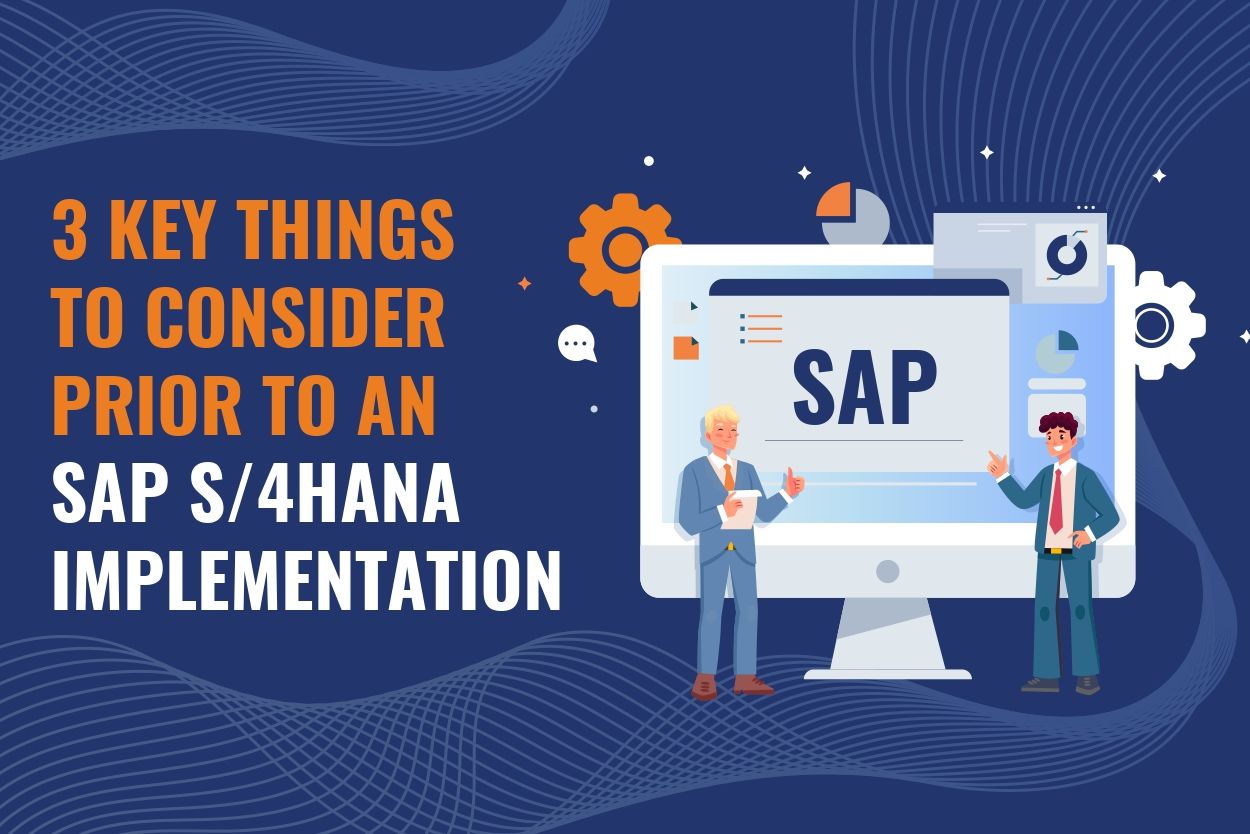
Businesses may guarantee a smooth and successful SAP S/4HANA implementation by taking the time to think about these three crucial factors: choosing the best SAP consulting services partner and preparing for change management.
In today’s world, every organization must invest significantly in the SAP S/4HANA implementation process. It can change how a business runs, streamlining procedures and boosting output. To ensure a successful SAP implementation, it’s crucial to think about a few important criteria before starting such a project. In this blog, we’ll go over three essential things to think about before implementing SAP S/4HANA into practice.
The process of installing, configuring, and customizing the SAP S/4HANA software to fit the unique business requirements of an organization is known as SAP S/4HANA implementation. The next-generation ERP (Enterprise Resource Planning) system SAP S/4HANA offers real-time data analytics so that businesses can streamline their operational procedures. A number of steps are included in the implementation process, such as system design, data migration, user training, and testing. The ultimate purpose of SAP S/4HANA installation is to assist businesses in enhancing operational effectiveness, cutting expenses, and boosting profitability. This enhances ERP implementation further.
When choosing an SAP consulting services provider, consider the following:
–Industry expertise: Look for a consulting partner with experience in your industry. They should be familiar with your business processes, regulations, and compliance requirements.
–Technical expertise: Your consulting partner should have a team of experienced and certified SAP consultants who can design, configure, and implement SAP S/4HANA solutions tailored to your business needs.
–Proven track record: Look for a consulting partner with a proven track record of successful SAP implementation projects.
-Support services: Consider the support services that the consulting partner provides after the implementation is complete. Will they provide ongoing maintenance and support?
-Phases: Determine the phases of the implementation project. For example, the implementation project can be divided into the planning phase, blueprinting phase, realization phase, and go-live phase.
-Timeline: Define a realistic timeline for the implementation project. Make sure you take into account any critical dates, such as financial year-end, that may impact the implementation schedule.
-Budget: Define a budget for the implementation project. Consider the costs of hardware, software, licenses, and consulting services.
-Resources: Determine the resources required for the project, such as hardware, software, and human resources. Make sure you have the necessary resources in place to complete the project on time and within budget.
-Data quality: Ensure that the data in your existing system is accurate, complete, and up-to-date. This will reduce the risk of errors during data migration.
-Mapping: Define the mapping between the data in your existing system and the data in SAP S/4HANA. This will ensure that the data is migrated to the correct fields in the new system.
-Testing: Test the data migration process to identify and resolve any issues before go-live.
-Downtime: Plan for system downtime during the data migration process. Make sure you have a backup plan in place in case of any issues during the migration.
SAP S/4HANA implementation is a difficult procedure that needs careful preparation and consideration. Businesses may guarantee a smooth and successful implementation by taking the time to think about these three crucial factors: choosing the best SAP consulting services partner, preparing for change management, and detecting data transfer difficulties. It’s crucial to keep in mind that this is a continual process that calls for ongoing monitoring and optimization. In order to know more about SAP S/4HANA implementation, visit our websites.
Enterprise transformation is no longer a niche service—it has become a critical driver for organizations seeking growth, agility, and resilience. Businesses today face unprecedented challenges: rapidly evolving technologies, shifting customer expectations, and complex global markets. In response, transformation consulting has evolved from offering generic recommendations to delivering highly specialized, strategic guidance that helps enterprises navigate this dynamic landscape.
Understanding how consulting is changing provides insights into what the future of enterprise transformation consulting looks like, and why companies are increasingly relying on experts to guide their transformational journeys.
Read More
Artificial intelligence is quickly moving from experimentation to real business impact. Organizations are using AI to automate decisions, improve customer experiences, and extract insights from massive volumes of data. However, simply adopting AI tools does not guarantee success. Many companies discover that their existing workflows were never designed to support intelligent automation.
To unlock the full potential of AI, businesses must rethink how their processes are structured. This is where business process transformation becomes essential. Organizations need AI-ready processes that are structured, data-driven, and adaptable. Without these foundations, even the most advanced AI systems struggle to deliver value.
Understanding how to prepare processes for AI helps businesses build systems that are not only efficient today but also capable of evolving with future technologies.
Read More
Businesses today are under constant pressure to move faster, operate efficiently, and deliver better customer experiences. In response, many organizations invest in automation tools and digital technologies. However, a common misunderstanding arises when companies assume automation alone equals transformation.
In reality, automation vs transformation is not a comparison of competing strategies. Instead, automation is a component of digital transformation, not the transformation itself. Understanding this distinction is essential for organizations that want to achieve meaningful and lasting change.
When leaders realize that automation is not digital transformation, they can approach technology adoption more strategically and avoid investing in tools that produce only limited impact.
Read More
In today’s fast-paced business landscape, uncertainty is the only constant. From global economic shifts to rapid technological change, organizations face pressures that can disrupt operations, challenge growth, and threaten survival. In this environment, organizational resilience is no longer optional—it is essential. Companies that cultivate adaptability, foresight, and responsiveness are better equipped to thrive, even under the most challenging circumstances.
How companies stay resilient begins with a mindset that sees disruption not as a threat, but as an opportunity to learn, evolve, and innovate. Resilient organizations do more than recover from setbacks—they anticipate challenges, respond effectively, and emerge stronger.
Read More
In today’s fast-paced digital landscape, businesses must adapt to changing technologies and customer expectations to remain competitive. One of the most effective ways to achieve this adaptability is through digital transformation, which involves integrating digital technologies into all areas of a business. A critical component of this transformation is Enterprise Resource Planning (ERP) systems.
Read More
Implementing an SAP system can be a transformative step for organizations aiming to enhance their operational efficiency, streamline processes, and improve data visibility. However, success in an SAP implementation goes beyond simply completing the project on time and within budget. It involves measuring and analyzing key performance metrics that provide insight into how effectively the system is being utilized and whether it meets the organization’s objectives.
Read More
In today’s fast-paced business environment, efficient systems and processes are vital for success. Enterprise Resource Planning (ERP) systems like SAP are central to this, helping organizations streamline their operations, manage resources more effectively, and drive productivity.
However, ERP implementation is a complex and often challenging process that requires a skilled IT consulting partner to ensure success. Selecting the right IT consulting services for your ERP implementation, especially for SAP, can make the difference between seamless integration and costly disruptions.
Read More
ERP systems have become indispensable tools for businesses looking to streamline operations, improve efficiency, and maintain a competitive edge. However, implementing ERP solutions can be daunting, especially for small and medium-sized businesses (SMBs) with limited resources.
The complexity of the process, cost concerns, and the need for seamless integration across departments pose significant challenges. To overcome these, SMBs must adopt tailored ERP implementation strategies that align with their unique requirements.
Read More
In today’s fast-paced business environment, Enterprise Resource Planning (ERP) systems like SAP (Systems, Applications, and Products) are crucial to streamlining operations, improving efficiency, and supporting growth. However, the process of SAP implementation can be complex and time-consuming, often putting a strain on internal resources.
This is where IT consulting services come into play, providing the necessary expertise and support to accelerate your SAP implementation timeline. By leveraging specialized knowledge and proven strategies, IT consulting services can significantly shorten the time required for successful SAP deployment, helping organizations stay competitive and responsive to market demands.
Read More
As enterprises scale, managing resources, streamlining operations, and maintaining flexibility become crucial challenges. To address these challenges, businesses increasingly turn to cloud-based Enterprise Resource Planning (ERP) systems.
ERP solutions have long been vital in centralizing various business functions like finance, human resources, supply chain management, and customer relations into a unified system. In recent years, the shift to cloud-based ERP systems has offered even greater benefits, particularly for growing enterprises.
Read More
Leave a Reply