
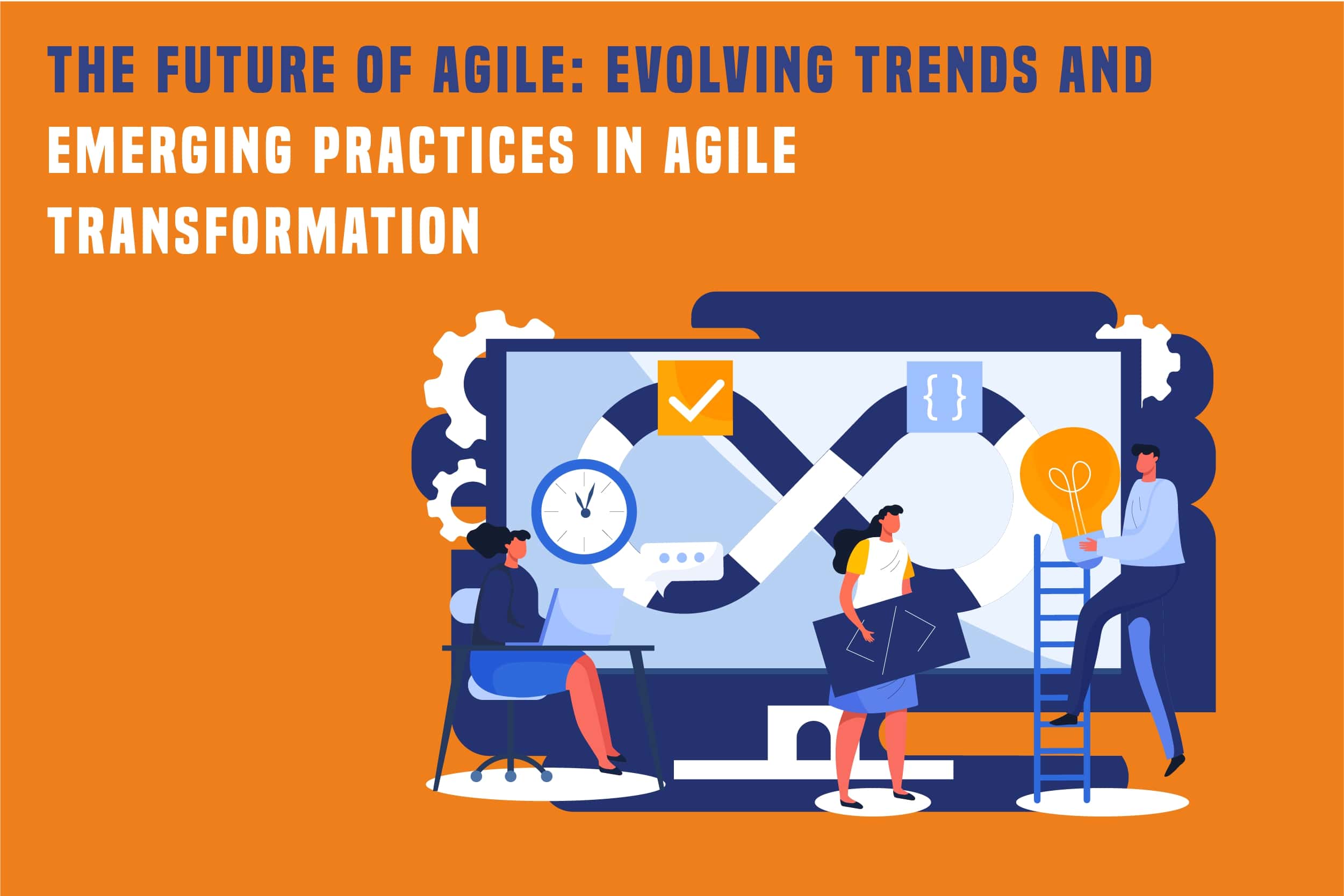
The future of Agile is an exciting frontier, marked by evolving trends and emerging practices that continue to redefine how organizations approach software development and organizational agility. As businesses navigate increasingly complex and dynamic environments, the principles and methodologies of Agile are undergoing rapid evolution to meet the demands of the modern digital landscape.
One of the key trends shaping the future of Agile transformation is the integration of Agile principles beyond traditional software development teams. Agile principles’ widespread adoption fuels enterprise-wide transformation, fostering seamless collaboration among cross-functional teams for faster, more efficient customer value delivery.
Another significant trend is the convergence of Agile with other disciplines such as DevOps, Lean, and Design Thinking. Combining the principles and practices of these complementary frameworks enhances the effectiveness of Agile transformation efforts, creating synergies within organizations. Similarly, Lean principles emphasizing waste reduction and value stream optimization can complement Agile practices by streamlining workflows and improving efficiency.
Emerging practices in Agile transformation are also reshaping how organizations approach key aspects of software development and delivery. For instance, there is a growing emphasis on outcome-based Agile metrics. It focuses on measuring business value and customer satisfaction rather than traditional metrics like velocity or story points.
Additionally, Agile transformation is increasingly being driven by a culture of continuous learning and experimentation. Organizations embrace practices such as Lean Startup and Design Thinking to foster innovation. This iterates on ideas quickly, and responds rapidly to changing market conditions.
So, the future of Agile transformation is characterized by a dynamic interplay of evolving trends and emerging practices reshaping how organizations approach software development and organizational agility. Organizations can lead by adopting trends, driving change, and seizing growth opportunities in a fast-paced digital landscape for success.
Agile methodology has become synonymous with adaptability, collaboration, and efficiency in software development and project management. Its principles, initially outlined in the Agile Manifesto over two decades ago, have since revolutionized how teams approach complex projects.
As technology evolves and business landscapes shift, continuous evolution and adaptation mark the future of Agile. This blog will delve into the evolving trends and emerging practices shaping Agile transformation in the years to come.
Several developing themes in the dynamic field of agile transformation influence how organizations approach this process. Agile frameworks like SAFe and LeSS, integrating DevOps processes, and emphasizing expanding agile outside IT departments are becoming more popular. Furthermore, there is a growing trend towards a culture that prioritizes client satisfaction and ongoing development. Agile methods that consider these new dynamics are also becoming more and more necessary as remote work. These distributed teams become increasingly common for the organizations.
So, traditional Agile methodologies were primarily designed for small, co-located teams of the organization. However, as organizations scale up and projects grow in complexity, there’s a growing need for Agile frameworks that accommodate larger teams and distributed workforces.
Scaling frameworks such as SAFe (Scaled Agile Framework), LeSS (Large-Scale Scrum), and Nexus have gained prominence, providing structured approaches to Agile at scale. These frameworks emphasize alignment, collaboration, and coordination across multiple teams while preserving Agile values and principles.
DevOps practices have become integral to Agile transformations, focusing on collaboration between development and operations teams. As an IT solution consultant, your role is to facilitate DevOps practices and foster collaboration between development and operations teams. DevOps complements Agile by automating software delivery pipelines, enhancing deployment frequency, and fostering a culture of continuous improvement.
The future of Agile sees a deeper integration of DevOps practices within Agile methodologies, blurring the lines between development, operations, and quality assurance. This convergence, often called “DevOps Agile” or “Agile DevOps,” aims to streamline the end-to-end software delivery lifecycle.
While Agile originated within software development, its principles have transcended IT boundaries. These are embraced by non-technical domains such as marketing, HR, finance, and government of the organization. This expansion of Agile beyond IT, often called “Business Agility,” involves adapting Agile principles to suit diverse business functions. Teams outside of IT leverage Agile frameworks like Scrum and Kanban to enhance collaboration, respond to changing market demands, and deliver value more efficiently.
Traditional hierarchical leadership models are giving way to more Agile leadership approaches that empower teams, foster innovation, and promote a culture of trust and accountability.
Agile leaders are facilitators rather than controllers and focus on removing impediments. Moreover, it nurtures a growth mindset and aligns organizational goals with team objectives. Leadership agility is crucial to successful business transformation, driving cultural change and enabling adaptive organizations.
Scaling agility across whole organizations, adopting lean portfolio management, and incorporating DevOps concepts are the main focuses of emerging approaches in agile transformation. Agile coaching and leadership are essential to promoting continuous development and cultivating agile attitudes. Value stream mapping makes operations more efficient, and feedback loops and agile metrics help with data-driven decision-making. Agile HR fosters talent development, while agile governance guarantees compliance with legal standards. So, customer interaction and agile marketing encourage flexibility and reaction.
As organizations embark on Agile transformations, Agile coaches and mentors’ roles become indispensable. These professionals provide guidance, support, and expertise to teams and leaders navigating the complexities of Agile adoption.
Beyond initial training, Agile coaches help teams embed Agile principles into their workflows, navigate organizational challenges, and continuously improve their Agile practices. They serve as catalysts for change, fostering a culture of learning and experimentation.
Effective Agile transformations rely on data-driven insights to measure progress, identify bottlenecks, and optimize performance. Agile metrics go beyond traditional productivity measures and incorporate qualitative team health and project success indicators.
Emerging practices in Agile metrics include using tools like cycle time, lead time, and cumulative flow diagrams to visualize workflow efficiency, sentiment analysis and retrospective feedback to gauge team morale and engagement.
Agile organizations thrive on a culture of experimentation and innovation, encouraging teams to embrace uncertainty, take calculated risks, and learn from failure. In this case, an IT solution consultant plays a vital role in developing the organization’s business growth.
Practices such as Lean Startup, Design Thinking, and Lean UX are being integrated into Agile frameworks to foster creativity. It helps to validate assumptions, and deliver customer-centric solutions iteratively. So, this emphasis on experimentation fuels continuous improvement and drives business agility.
The COVID-19 pandemic accelerated the adoption of remote work practices, challenging Agile teams to adapt to distributed collaboration and virtual environments. Remote Agile practices leverage digital tools, virtual ceremonies, and asynchronous communication channels to enable effective. In addition, collaboration and maintaining Agile rituals despite geographical barriers. Practices like remote pair programming, virtual whiteboarding, and online retrospectives are becoming increasingly prevalent.
The organizations navigate an increasingly complex and dynamic business transformation landscape. Agile transformation remains a cornerstone of the organization’s resilience, adaptability, and innovation. By embracing evolving trends such as Agile at scale, DevOps integration, Business Agility, and Agile leadership. It is adopting emerging practices like Agile coaching, metrics-driven decision-making, experimentation, and remote Agile. So, the businesses can position themselves for success in the future of Agile. The journey towards Agile maturity requires continuous learning, adaptation, and a steadfast commitment to Agile values and principles. For more information, visit our website.
Artificial intelligence is transforming how modern businesses operate. From automating workflows to generating insights from massive datasets, AI offers organizations unprecedented opportunities to innovate and scale. However, as AI capabilities grow, so do concerns around ethics, accountability, and transparency. This is why responsible AI has become a critical priority for large organizations.
Read More
Digital transformation has become a strategic priority for organizations across industries. Businesses are investing in advanced technologies, data platforms, and automation tools to improve efficiency and remain competitive in an increasingly digital world. However, transformation initiatives are rarely simple. Many organizations underestimate the complexity of change, leading to delays, wasted investments, or stalled projects.
Read More
For many organizations, legacy systems are both a foundation and a barrier. These older technologies once powered growth, managed operations, and supported critical business functions. Over time, however, they often become difficult to maintain, expensive to update, and incompatible with modern tools. As markets evolve and customer expectations rise, businesses increasingly recognize the need for legacy modernization.
Read More
Digital transformation promises speed, innovation, and competitive advantage. Yet, despite heavy investments in new technologies, many organizations struggle to achieve meaningful results. In fact, digital transformation failure is more common than most companies expect. Businesses launch ambitious initiatives to modernize systems, adopt AI, or improve customer experiences, but somewhere along the way, momentum fades.
Understanding why digital transformations fail requires looking beyond technology. The real problems often lie in strategy, culture, leadership, and execution. When these elements are misaligned, even the most advanced tools cannot deliver transformation.
Below are some of the most common enterprise transformation challenges that cause digital initiatives to stall or collapse.
Read More
Artificial intelligence is quickly moving from experimentation to enterprise-wide implementation. Many organizations have already tested AI through pilot projects, automation tools, or analytics platforms. The next step—scaling AI across the organization—promises greater efficiency, smarter decision-making, and new business opportunities.
However, expanding AI initiatives without the right structure can create confusion rather than progress. Disconnected tools, unclear governance, and untrained teams often turn promising projects into operational headaches. For companies pursuing enterprise AI adoption, the real challenge is learning how to scale AI safely while maintaining control, consistency, and trust.
Successfully scaling AI requires thoughtful planning, strong governance, and a focus on people as much as technology.
Read More
Businesses evolve constantly. Markets change, customer expectations rise, and new technologies reshape how companies operate. To keep up, organizations often need more than new tools or strategies—they need to rethink how the entire business functions. This is where operating model transformation comes in.
While the phrase may sound complex, the concept is actually quite simple. It is about redesigning how a company works so that it can deliver value more efficiently, adapt faster, and support long-term growth.
Understanding what is an operating model transformation helps leaders make better decisions about people, processes, and technology.
Read More
Enterprise transformations are complex, high-stakes initiatives that often promise operational efficiency, digital modernization, and competitive advantage. Yet, despite meticulous planning and substantial investments, many transformation programs stumble—not because of technology, but because of people.
This is where change management becomes critical. Understanding why people resist change and applying effective strategies in transformation leadership can make the difference between a stalled project and a successful enterprise-wide transformation.
Read More
Artificial Intelligence (AI) is no longer a futuristic concept; it has become a cornerstone of modern business strategy. From automating routine tasks to generating insights from vast datasets, AI promises efficiency, innovation, and competitive advantage.
Yet, the rapid pace of AI adoption also brings uncertainty. Many executives struggle with defining their role in AI strategy, leading to stalled projects or missed opportunities. Understanding how leaders should think about Artificial Intelligence is essential for turning technology into tangible business outcomes.
Read More
Digital transformation is no longer just a buzzword—it’s a necessity for businesses aiming to stay competitive in today’s fast-paced market. Organizations invest in cloud technologies, automation, AI, and customer-centric platforms to modernize operations and create value. But with so many initiatives underway, one pressing question arises: how to measure transformation success? Without clear metrics, companies risk investing heavily without knowing whether their efforts are truly paying off.
Measuring success in digital transformation goes beyond counting deployed tools or completed projects. It requires tracking meaningful indicators that reflect actual business outcomes, employee adoption, and customer impact. Defining transformation KPIs early in the journey ensures that initiatives stay aligned with strategic goals and deliver measurable value.
Read More
Enterprise transformation is no longer a niche service—it has become a critical driver for organizations seeking growth, agility, and resilience. Businesses today face unprecedented challenges: rapidly evolving technologies, shifting customer expectations, and complex global markets. In response, transformation consulting has evolved from offering generic recommendations to delivering highly specialized, strategic guidance that helps enterprises navigate this dynamic landscape.
Understanding how consulting is changing provides insights into what the future of enterprise transformation consulting looks like, and why companies are increasingly relying on experts to guide their transformational journeys.
Read More

Leave a Reply