
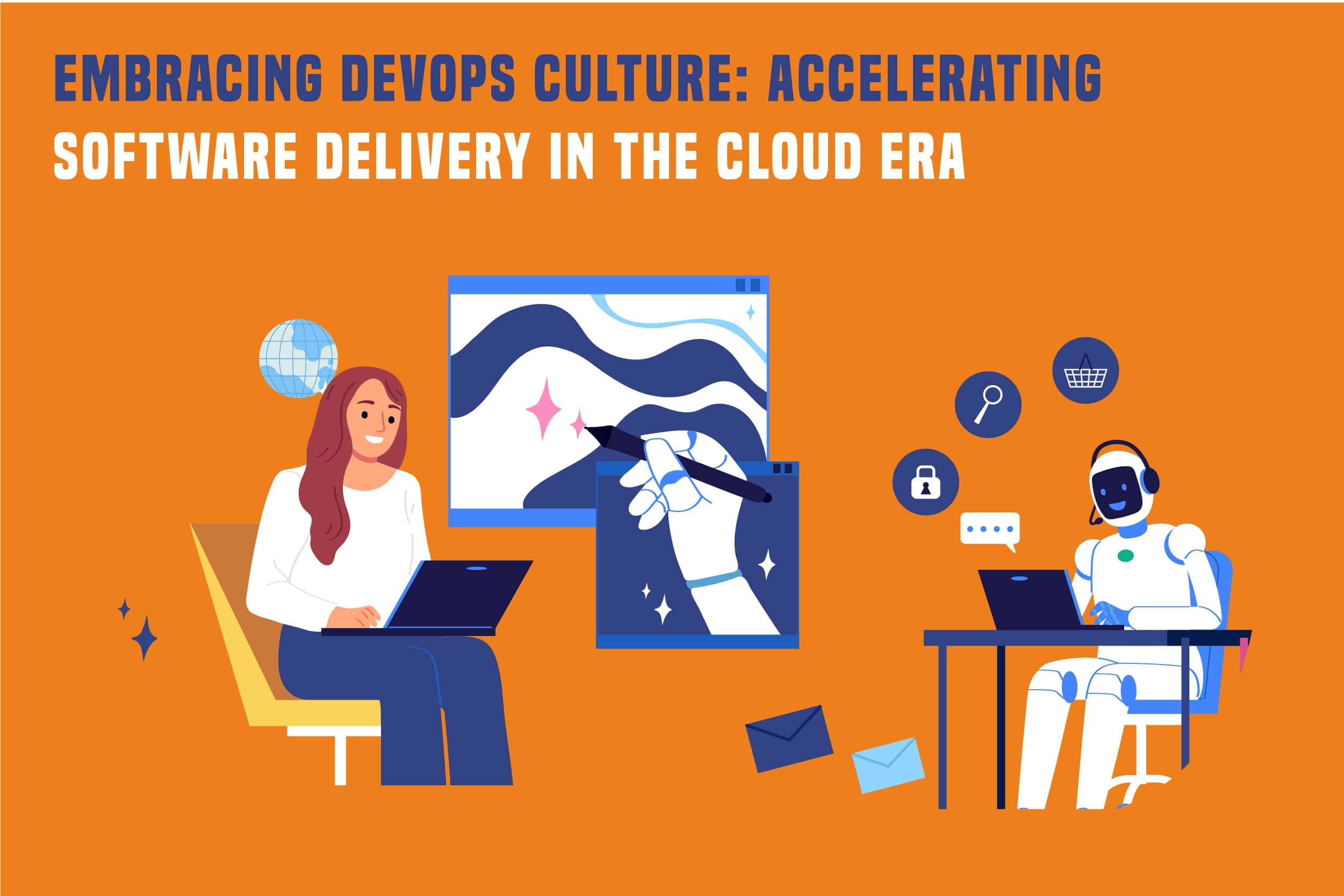
In today’s rapidly evolving technological landscape, embracing DevOps culture has become imperative for organizations striving to remain competitive. DevOps, a portmanteau of Development and Operations, represents a cultural shift that fosters collaboration between software development. IT operations teams, aiming to automate and streamline the software delivery process. This collaboration accelerates software development and deployment, enabling organizations to respond swiftly to market demands and customer feedback.
The advent of the cloud era has revolutionized how software is developed, deployed, and managed. Cloud transformation has provided organizations with scalable infrastructure, on-demand resources, and unparalleled flexibility. So, it is empowering them to innovate rapidly and deliver value to their customers with unprecedented speed.
Organizations can achieve several vital benefits by embracing DevOps culture in the cloud era. They can accelerate the development lifecycle, from code commit to production deployment, by automating repetitive tasks and implementing continuous integration and delivery (CI/CD) pipelines. This enables teams to rapidly deliver new features and updates to customers, enhancing competitiveness and customer satisfaction.
Furthermore, DevOps practices coupled with cloud transformation enable organizations to optimize resource utilization, reduce infrastructure costs, and enhance scalability. With cloud-native technologies such as containers and serverless computing, teams can deploy applications more efficiently. So, scale resources dynamically based on demand, and achieve higher levels of availability and reliability.
Moreover, DevOps empowers teams to embrace a culture of continuous improvement and experimentation. It is encouraging iterative development, feedback loops, and data-driven decision-making. By embracing failure as an opportunity to learn and innovate, organizations can foster a culture of resilience and adaptability, driving business growth.
So, embracing DevOps culture in the cloud era is essential for organizations seeking to accelerate software delivery, innovate rapidly, and thrive in a competitive marketplace. By combining DevOps principles with cloud transformation, organizations can unlock. The new opportunities for growth, agility, and success, positioning themselves as leaders in their respective industries.
Cloud computing has revolutionized how software is developed, deployed, and managed. Cloud platforms offer unparalleled scalability, flexibility, and efficiency, enabling organizations to innovate and rapidly deliver value to their customers. However, realizing the full potential of the cloud requires more than just adopting new technologies. We will discuss the challenges organizations face when embarking on DevOps and cloud transformation journeys and provide practical strategies and best practices for overcoming these challenges.
At its core, DevOps is a cultural and philosophical movement that aims to break down silos between development and operations teams. It fosters collaboration, communication, and continuous improvement. Unlike traditional waterfall approaches, where development, testing, and operations are treated as separate phases. DevOps promotes a holistic, end-to-end approach to software delivery.
Faster Time-to-Market: By automating manual tasks, streamlining processes, and fostering collaboration, DevOps enables organizations to accelerate software delivery cycles, reducing time-to-market from months to weeks or even days.
Embracing a DevOps culture can bring numerous benefits to organizations, such as improved collaboration, faster delivery of software, increased reliability, and better responsiveness to customer needs. However, there are also several challenges associated with adopting DevOps practices. Some of these challenges include:
Overcoming the challenges of embracing DevOps culture requires a comprehensive approach that addresses cultural, organizational, technical, and procedural aspects.Here are a few approaches to tackle these challenges:
Several leading organizations have successfully embraced DevOps culture and practices to accelerate software delivery in the cloud era. For example, Amazon Web Services (AWS) leverages DevOps to continuously innovate and deliver new features and services to millions of customers worldwide. Similarly, Netflix has built a highly resilient and scalable platform using. So, DevOps principles, enabling it to deliver a seamless streaming experience to over 200 million subscribers globally.
So, embracing DevOps culture is essential for accelerating software delivery in the cloud computing era. By breaking down silos, fostering collaboration, automating processes, and embracing continuous improvement, organizations can deliver higher-quality software faster and more reliably, enabling them to stay competitive and drive business growth in today’s fast-paced digital economy. Organizations adopting DevOps practices and principles will be better positioned to innovate, adapt, and thrive in an ever-changing landscape. For more information, visit our website.
Artificial intelligence is transforming how modern businesses operate. From automating workflows to generating insights from massive datasets, AI offers organizations unprecedented opportunities to innovate and scale. However, as AI capabilities grow, so do concerns around ethics, accountability, and transparency. This is why responsible AI has become a critical priority for large organizations.
Read More
Digital transformation has become a strategic priority for organizations across industries. Businesses are investing in advanced technologies, data platforms, and automation tools to improve efficiency and remain competitive in an increasingly digital world. However, transformation initiatives are rarely simple. Many organizations underestimate the complexity of change, leading to delays, wasted investments, or stalled projects.
Read More
For many organizations, legacy systems are both a foundation and a barrier. These older technologies once powered growth, managed operations, and supported critical business functions. Over time, however, they often become difficult to maintain, expensive to update, and incompatible with modern tools. As markets evolve and customer expectations rise, businesses increasingly recognize the need for legacy modernization.
Read More
Digital transformation promises speed, innovation, and competitive advantage. Yet, despite heavy investments in new technologies, many organizations struggle to achieve meaningful results. In fact, digital transformation failure is more common than most companies expect. Businesses launch ambitious initiatives to modernize systems, adopt AI, or improve customer experiences, but somewhere along the way, momentum fades.
Understanding why digital transformations fail requires looking beyond technology. The real problems often lie in strategy, culture, leadership, and execution. When these elements are misaligned, even the most advanced tools cannot deliver transformation.
Below are some of the most common enterprise transformation challenges that cause digital initiatives to stall or collapse.
Read More
Artificial intelligence is quickly moving from experimentation to enterprise-wide implementation. Many organizations have already tested AI through pilot projects, automation tools, or analytics platforms. The next step—scaling AI across the organization—promises greater efficiency, smarter decision-making, and new business opportunities.
However, expanding AI initiatives without the right structure can create confusion rather than progress. Disconnected tools, unclear governance, and untrained teams often turn promising projects into operational headaches. For companies pursuing enterprise AI adoption, the real challenge is learning how to scale AI safely while maintaining control, consistency, and trust.
Successfully scaling AI requires thoughtful planning, strong governance, and a focus on people as much as technology.
Read More
Businesses evolve constantly. Markets change, customer expectations rise, and new technologies reshape how companies operate. To keep up, organizations often need more than new tools or strategies—they need to rethink how the entire business functions. This is where operating model transformation comes in.
While the phrase may sound complex, the concept is actually quite simple. It is about redesigning how a company works so that it can deliver value more efficiently, adapt faster, and support long-term growth.
Understanding what is an operating model transformation helps leaders make better decisions about people, processes, and technology.
Read More
Enterprise transformations are complex, high-stakes initiatives that often promise operational efficiency, digital modernization, and competitive advantage. Yet, despite meticulous planning and substantial investments, many transformation programs stumble—not because of technology, but because of people.
This is where change management becomes critical. Understanding why people resist change and applying effective strategies in transformation leadership can make the difference between a stalled project and a successful enterprise-wide transformation.
Read More
Artificial Intelligence (AI) is no longer a futuristic concept; it has become a cornerstone of modern business strategy. From automating routine tasks to generating insights from vast datasets, AI promises efficiency, innovation, and competitive advantage.
Yet, the rapid pace of AI adoption also brings uncertainty. Many executives struggle with defining their role in AI strategy, leading to stalled projects or missed opportunities. Understanding how leaders should think about Artificial Intelligence is essential for turning technology into tangible business outcomes.
Read More
Digital transformation is no longer just a buzzword—it’s a necessity for businesses aiming to stay competitive in today’s fast-paced market. Organizations invest in cloud technologies, automation, AI, and customer-centric platforms to modernize operations and create value. But with so many initiatives underway, one pressing question arises: how to measure transformation success? Without clear metrics, companies risk investing heavily without knowing whether their efforts are truly paying off.
Measuring success in digital transformation goes beyond counting deployed tools or completed projects. It requires tracking meaningful indicators that reflect actual business outcomes, employee adoption, and customer impact. Defining transformation KPIs early in the journey ensures that initiatives stay aligned with strategic goals and deliver measurable value.
Read More
Enterprise transformation is no longer a niche service—it has become a critical driver for organizations seeking growth, agility, and resilience. Businesses today face unprecedented challenges: rapidly evolving technologies, shifting customer expectations, and complex global markets. In response, transformation consulting has evolved from offering generic recommendations to delivering highly specialized, strategic guidance that helps enterprises navigate this dynamic landscape.
Understanding how consulting is changing provides insights into what the future of enterprise transformation consulting looks like, and why companies are increasingly relying on experts to guide their transformational journeys.
Read More

Leave a Reply