
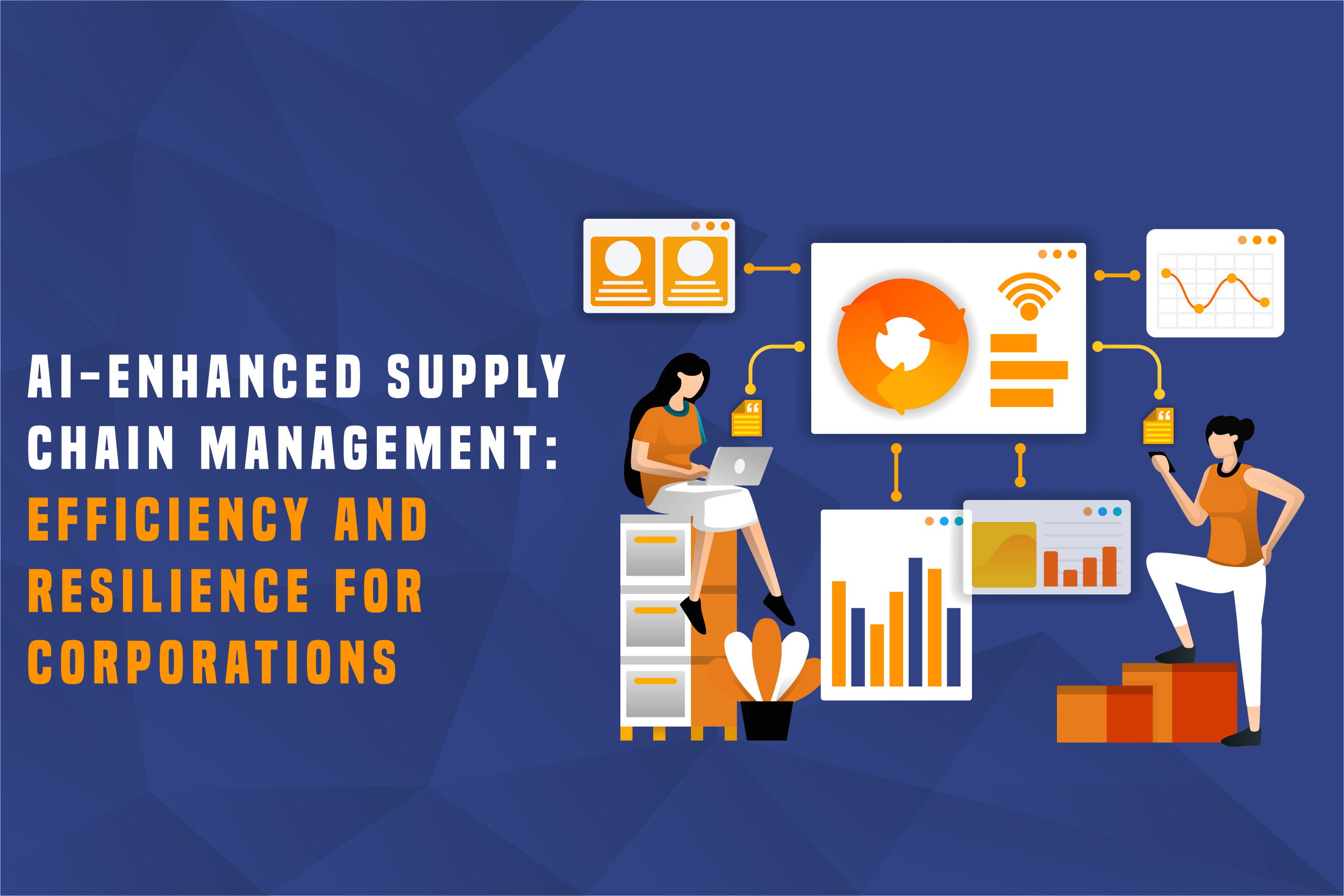
Artificial Intelligence (AI) has emerged as a transformative force in revolutionizing corporate supply chains, ushering in unprecedented efficiency and resilience. So, this technological prowess enables organizations to optimize their supply chain management and operations, addressing challenges and unlocking new productivity levels.
At the heart of this transformation lies the ability of AI to process vast amounts of data swiftly and accurately. Through advanced algorithms and machine learning models, AI analyzes historical and real-time data, offering invaluable insights into demand. It forecasts inventory management, and overall supply chain dynamics. By predicting trends and identifying patterns, AI empowers businesses to make data-driven decisions, minimizing uncertainties and optimizing resource allocation.
One key area where Artificial intelligence excels is demand forecasting of the organization. Traditional methods often fall short in predicting market fluctuations, leading to either excess inventory or stockouts. AI, however, leverages predictive analytics to forecast demand with remarkable precision. So, this ensures that products are available when needed and minimizes excess inventory, reducing costs and improving overall efficiency.
Moreover, AI enhances inventory management by continuously monitoring stock levels, supplier performance, and order fulfillment processes. Intelligent algorithms can automatically adjust inventory levels based on demand fluctuations, preventing overstocking or understocking scenarios. This dynamic approach not only streamlines operations but also minimizes the risk of disruptions in the supply chain.
Regarding operational efficiency, AI-driven solutions facilitate predictive maintenance for machinery and equipment. By analyzing sensor data and historical performance, AI can predict when equipment will likely fail, allowing for proactive maintenance and reducing downtime. So, this improves operational efficiency, contributes to cost savings, and extends the lifespan of assets.
From demand forecasting and inventory management to predictive maintenance and risk mitigation, AI-driven solutions offer a holistic approach to optimizing supply chain management and operations. As businesses navigate an ever-evolving landscape, embracing AI is a technological advancement and a strategic imperative for staying competitive and robust in constant change.
The global supply chain comprises a complex and interconnected network that spans the globe, encompassing the flow of materials, information, and goods. Artificial Intelligence (AI) has emerged as a game-changer in supply chain management in recent years. Efficient supply chain management is crucial for corporations because it directly impacts their operational costs, customer satisfaction, and competitive advantage. So, AI-powered solutions promise to enhance efficiency, optimize processes, and fortify supply chain resilience. In this blog, we will delve into the significance of AI in supply chain management, its various applications, and the myriad benefits it brings to corporations.
Supply chain management involves many complex processes, including demand forecasting, inventory management, logistics, and distribution. Traditionally, these operations have been managed through human judgment, experience, and legacy systems. However, AI introduces a paradigm shift in how supply chains can be ordered and optimized.
Accurately predicting demand is one of the key challenges in supply chain management. AI-powered forecasting models can analyze historical data, market trends, and external factors like weather patterns and geopolitical events to provide more accurate demand forecasts. This ensures that corporations maintain optimal inventory levels, preventing overstocking or stockouts.
AI can optimize inventory management by continuously analyzing sales data, production schedules, and lead times to determine the ideal stock levels. By avoiding excess inventory and ensuring the availability of products, companies can significantly reduce carrying costs and minimize the risk of obsolescence.
AI algorithms can optimize logistics and routing by selecting the most efficient transportation routes and schedules. Businesses may utilize IT consulting services to manage the challenges of incorporating AI into logistics and routing. So, this can reduce transportation costs, minimize delivery times, and lower the environmental impact of supply chain operations.
AI can evaluate supplier performance by monitoring delivery times, product quality, and pricing. So, this helps identify and mitigate supply chain risks and ensures that corporations work with reliable partners.
Additionally, AI-powered predictive maintenance solutions can monitor the condition of machinery and equipment in the supply chain. Corporations can reduce unplanned downtime and lower maintenance costs by predicting when maintenance is needed.
AI streamlines various supply chain processes, reducing manual work and the risk of errors. This results in improved efficiency, reduced lead times and enhanced productivity.
Additionally, AI can help supply chains become more resilient by providing real-time insights and predictive analytics. This allows corporations to adapt quickly to disruptions, such as natural disasters or supply chain interruptions.
Efficiency gains, better inventory management, and optimized logistics lead to cost savings. So, AI can help corporations reduce operational costs and enhance profitability.
Corporations can enhance customer satisfaction by accurately forecasting demand and ensuring product availability. Timely deliveries and reduced stockouts lead to happier customers.
Corporations that embrace AI in supply chain management gain a competitive edge. So, they can adapt faster to market changes, respond to customer needs more effectively, and operate cost-effectively.
A key player in using AI for predictive analytics in several areas of supply chain management is an IT consulting services company. So, these insights help corporations make data-driven decisions.
Machine learning algorithms can optimize inventory levels, monitor supplier performance, and improve demand forecasting by learning from past data and adapting to changing circumstances.
NLP can be used for sentiment analysis of customer reviews and social media data. This provides valuable insights into customer preferences and market trends.
IoT sensors can be integrated into the supply chain to provide real-time data on product location, temperature, and other variables. This helps in tracking and monitoring goods in transit.
Blockchain technology can enhance transparency and traceability in the supply chain. It ensures that every transaction and movement of goods is recorded and can be verified, reducing the risk of fraud or counterfeiting.
While the potential of AI in supply chain management is immense, corporations must address several challenges and considerations when implementing AI solutions.
IT consulting services establish processes for continuous data quality improvement.
Integrating AI into existing supply chain processes may require a cultural shift and workflow changes. Employees may need training and support to adapt to these new technologies.
With the increased reliance on AI, there is a greater need to secure sensitive data and ensure that AI systems are protected from cyber threats.
Regulations like GDPR and HIPAA can impact the collection and use of data in AI systems. Corporations must ensure compliance with relevant data protection laws.
Implementing AI in supply chain management requires investment in technology, training, and infrastructure. Corporations must evaluate the expected return on investment and establish a clear business case for AI adoption.
Leveraging an IT consulting services company experience helps corporations effectively navigate AI challenges in supply chain management. By harnessing the power of AI for demand forecasting, inventory management, logistics optimization, and predictive maintenance. So, companies can streamline their supply chain operations and reap the benefits of cost reduction, enhanced customer satisfaction, and improved decision-making.
In a world where disruptions are expected and market dynamics are ever-changing,. So, AI has become an indispensable tool for corporations looking to stay ahead of the competition and build resilience. The supply chains by recognizing the significance of AI in supply chain management and addressing the associated challenges. So, corporations can position themselves for success in the increasingly dynamic and competitive global marketplace. For more information, visit our website.
Artificial intelligence is transforming how modern businesses operate. From automating workflows to generating insights from massive datasets, AI offers organizations unprecedented opportunities to innovate and scale. However, as AI capabilities grow, so do concerns around ethics, accountability, and transparency. This is why responsible AI has become a critical priority for large organizations.
Read More
Digital transformation has become a strategic priority for organizations across industries. Businesses are investing in advanced technologies, data platforms, and automation tools to improve efficiency and remain competitive in an increasingly digital world. However, transformation initiatives are rarely simple. Many organizations underestimate the complexity of change, leading to delays, wasted investments, or stalled projects.
Read More
For many organizations, legacy systems are both a foundation and a barrier. These older technologies once powered growth, managed operations, and supported critical business functions. Over time, however, they often become difficult to maintain, expensive to update, and incompatible with modern tools. As markets evolve and customer expectations rise, businesses increasingly recognize the need for legacy modernization.
Read More
Digital transformation promises speed, innovation, and competitive advantage. Yet, despite heavy investments in new technologies, many organizations struggle to achieve meaningful results. In fact, digital transformation failure is more common than most companies expect. Businesses launch ambitious initiatives to modernize systems, adopt AI, or improve customer experiences, but somewhere along the way, momentum fades.
Understanding why digital transformations fail requires looking beyond technology. The real problems often lie in strategy, culture, leadership, and execution. When these elements are misaligned, even the most advanced tools cannot deliver transformation.
Below are some of the most common enterprise transformation challenges that cause digital initiatives to stall or collapse.
Read More
Artificial intelligence is quickly moving from experimentation to enterprise-wide implementation. Many organizations have already tested AI through pilot projects, automation tools, or analytics platforms. The next step—scaling AI across the organization—promises greater efficiency, smarter decision-making, and new business opportunities.
However, expanding AI initiatives without the right structure can create confusion rather than progress. Disconnected tools, unclear governance, and untrained teams often turn promising projects into operational headaches. For companies pursuing enterprise AI adoption, the real challenge is learning how to scale AI safely while maintaining control, consistency, and trust.
Successfully scaling AI requires thoughtful planning, strong governance, and a focus on people as much as technology.
Read More
Businesses evolve constantly. Markets change, customer expectations rise, and new technologies reshape how companies operate. To keep up, organizations often need more than new tools or strategies—they need to rethink how the entire business functions. This is where operating model transformation comes in.
While the phrase may sound complex, the concept is actually quite simple. It is about redesigning how a company works so that it can deliver value more efficiently, adapt faster, and support long-term growth.
Understanding what is an operating model transformation helps leaders make better decisions about people, processes, and technology.
Read More
Enterprise transformations are complex, high-stakes initiatives that often promise operational efficiency, digital modernization, and competitive advantage. Yet, despite meticulous planning and substantial investments, many transformation programs stumble—not because of technology, but because of people.
This is where change management becomes critical. Understanding why people resist change and applying effective strategies in transformation leadership can make the difference between a stalled project and a successful enterprise-wide transformation.
Read More
Artificial Intelligence (AI) is no longer a futuristic concept; it has become a cornerstone of modern business strategy. From automating routine tasks to generating insights from vast datasets, AI promises efficiency, innovation, and competitive advantage.
Yet, the rapid pace of AI adoption also brings uncertainty. Many executives struggle with defining their role in AI strategy, leading to stalled projects or missed opportunities. Understanding how leaders should think about Artificial Intelligence is essential for turning technology into tangible business outcomes.
Read More
Digital transformation is no longer just a buzzword—it’s a necessity for businesses aiming to stay competitive in today’s fast-paced market. Organizations invest in cloud technologies, automation, AI, and customer-centric platforms to modernize operations and create value. But with so many initiatives underway, one pressing question arises: how to measure transformation success? Without clear metrics, companies risk investing heavily without knowing whether their efforts are truly paying off.
Measuring success in digital transformation goes beyond counting deployed tools or completed projects. It requires tracking meaningful indicators that reflect actual business outcomes, employee adoption, and customer impact. Defining transformation KPIs early in the journey ensures that initiatives stay aligned with strategic goals and deliver measurable value.
Read More
Enterprise transformation is no longer a niche service—it has become a critical driver for organizations seeking growth, agility, and resilience. Businesses today face unprecedented challenges: rapidly evolving technologies, shifting customer expectations, and complex global markets. In response, transformation consulting has evolved from offering generic recommendations to delivering highly specialized, strategic guidance that helps enterprises navigate this dynamic landscape.
Understanding how consulting is changing provides insights into what the future of enterprise transformation consulting looks like, and why companies are increasingly relying on experts to guide their transformational journeys.
Read More

Leave a Reply