
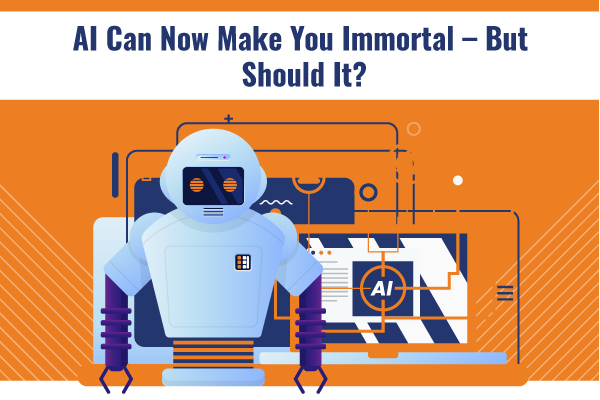
While AI has the potential to offer agile solutions and consulting services that can create a digital version of ourselves, we must consider the ethical and philosophical implications of digital immortality.
Technology’s newest buzzword, artificial intelligence (AI), has the potential to completely change how we work, live, and even pass away. Yep, you read that correctly: AI can now render you, or at least your digital persona, immortal. But should it?
A variety of businesses are at the forefront of AI development, continually coming up with new ideas to expand the realm of what is conceivable. Making a digital copy of yourself that can live on even after your physical body has died is one such option.
Your memories, experiences, and personality traits can all be recorded in this digital self, commonly referred to as a “mind file,” which can be accessed by AI algorithms. The question of the hour is, can AI and machine learning let us escape time and remain alive forever given all the achievements that have already been made in these fields? Let’s dive deep into the topic.
Even though it may seem like a plot from a science fiction novel, some individuals have already attained everlasting life through the use of AI. With companies like Eternime and Luka AI, people can now generate a “mind file” that can be stored for future generations, enabling access to a chatbot that utilizes natural language processing to simulate a conversation with the deceased.
At first glance, this may seem like a comforting idea, especially for those who have suffered the loss of a loved one. Being able to communicate with a digital representation of a deceased individual can bring solace and closure, and can also serve as a means of preserving family history and traditions. However, the notion of digital immortality as agile solutions raise ethical and philosophical questions.
For example, who has ownership of the “mind file” after the person has passed away? Should regulations be put in place to prevent the misuse of this technology? Can a digital self truly capture the essence of a person’s identity? How accurate is the digital representation of a person? Additionally, some argue that the concept of digital immortality reduces the value of real mortality.
Death is an essential part of life because it gives meaning and direction to our existence. If we eliminate death’s inevitable outcome, we risk underestimating the value of life and the experiences that come with it. Moreover, creating and maintaining a “mind file” for IT Consulting Services can be prohibitively costly, making it a luxury accessible mainly to the wealthy.
For some individuals, the notion of possessing a collection of deceased relatives on their hard drive, aware that they are no longer biologically alive but rather buried in the ground, may seem unsettling or reminiscent of a dystopian scenario. In 2020, a Korean TV documentary produced a virtual reality experience through artificial intelligence that reunited a mother with her deceased six-year-old daughter, enabling her to interact with a 3D-generated avatar by speaking to it or even reaching out to touch it. Several months later, the country organized a concert featuring a music star who had passed away 25 years earlier.
Additionally, ABBA, the Swedish pop legends, has been “on tour” for the past year, with their youthful digital avatars performing all of the shows. Another Korean firm recently unveiled a paid service that allows individuals to communicate with their deceased relatives. These advancements are still in their infancy, but they are already realistic enough to fill an emotional void. It’s only a matter of time before they become more robust, sophisticated, and available, and this could happen in just a few years, not decades. Nevertheless, we must remember that, despite their intelligence, these technologies are still reliant on our input and training in IT Consulting Services. This is why we must begin preparing for the future today by documenting and gathering all information about ourselves and our loved ones.
In conclusion, while AI has the potential to offer agile solutions and consulting services that can create a digital version of ourselves, we must consider the ethical and philosophical implications of digital immortality. While it may provide comfort and preservation of history, it may also devalue human mortality and raise concerns about access and equity. The decision to pursue digital immortality is a deeply personal one and should be made with careful consideration.
For many organizations, legacy systems are both a foundation and a barrier. These older technologies once powered growth, managed operations, and supported critical business functions. Over time, however, they often become difficult to maintain, expensive to update, and incompatible with modern tools. As markets evolve and customer expectations rise, businesses increasingly recognize the need for legacy modernization.
Read More
Digital transformation promises speed, innovation, and competitive advantage. Yet, despite heavy investments in new technologies, many organizations struggle to achieve meaningful results. In fact, digital transformation failure is more common than most companies expect. Businesses launch ambitious initiatives to modernize systems, adopt AI, or improve customer experiences, but somewhere along the way, momentum fades.
Understanding why digital transformations fail requires looking beyond technology. The real problems often lie in strategy, culture, leadership, and execution. When these elements are misaligned, even the most advanced tools cannot deliver transformation.
Below are some of the most common enterprise transformation challenges that cause digital initiatives to stall or collapse.
Read More
Artificial intelligence is quickly moving from experimentation to enterprise-wide implementation. Many organizations have already tested AI through pilot projects, automation tools, or analytics platforms. The next step—scaling AI across the organization—promises greater efficiency, smarter decision-making, and new business opportunities.
However, expanding AI initiatives without the right structure can create confusion rather than progress. Disconnected tools, unclear governance, and untrained teams often turn promising projects into operational headaches. For companies pursuing enterprise AI adoption, the real challenge is learning how to scale AI safely while maintaining control, consistency, and trust.
Successfully scaling AI requires thoughtful planning, strong governance, and a focus on people as much as technology.
Read More
Businesses evolve constantly. Markets change, customer expectations rise, and new technologies reshape how companies operate. To keep up, organizations often need more than new tools or strategies—they need to rethink how the entire business functions. This is where operating model transformation comes in.
While the phrase may sound complex, the concept is actually quite simple. It is about redesigning how a company works so that it can deliver value more efficiently, adapt faster, and support long-term growth.
Understanding what is an operating model transformation helps leaders make better decisions about people, processes, and technology.
Read More
Enterprise transformations are complex, high-stakes initiatives that often promise operational efficiency, digital modernization, and competitive advantage. Yet, despite meticulous planning and substantial investments, many transformation programs stumble—not because of technology, but because of people.
This is where change management becomes critical. Understanding why people resist change and applying effective strategies in transformation leadership can make the difference between a stalled project and a successful enterprise-wide transformation.
Read More
Artificial Intelligence (AI) is no longer a futuristic concept; it has become a cornerstone of modern business strategy. From automating routine tasks to generating insights from vast datasets, AI promises efficiency, innovation, and competitive advantage.
Yet, the rapid pace of AI adoption also brings uncertainty. Many executives struggle with defining their role in AI strategy, leading to stalled projects or missed opportunities. Understanding how leaders should think about Artificial Intelligence is essential for turning technology into tangible business outcomes.
Read More
Digital transformation is no longer just a buzzword—it’s a necessity for businesses aiming to stay competitive in today’s fast-paced market. Organizations invest in cloud technologies, automation, AI, and customer-centric platforms to modernize operations and create value. But with so many initiatives underway, one pressing question arises: how to measure transformation success? Without clear metrics, companies risk investing heavily without knowing whether their efforts are truly paying off.
Measuring success in digital transformation goes beyond counting deployed tools or completed projects. It requires tracking meaningful indicators that reflect actual business outcomes, employee adoption, and customer impact. Defining transformation KPIs early in the journey ensures that initiatives stay aligned with strategic goals and deliver measurable value.
Read More
Enterprise transformation is no longer a niche service—it has become a critical driver for organizations seeking growth, agility, and resilience. Businesses today face unprecedented challenges: rapidly evolving technologies, shifting customer expectations, and complex global markets. In response, transformation consulting has evolved from offering generic recommendations to delivering highly specialized, strategic guidance that helps enterprises navigate this dynamic landscape.
Understanding how consulting is changing provides insights into what the future of enterprise transformation consulting looks like, and why companies are increasingly relying on experts to guide their transformational journeys.
Read More
Artificial intelligence is quickly moving from experimentation to real business impact. Organizations are using AI to automate decisions, improve customer experiences, and extract insights from massive volumes of data. However, simply adopting AI tools does not guarantee success. Many companies discover that their existing workflows were never designed to support intelligent automation.
To unlock the full potential of AI, businesses must rethink how their processes are structured. This is where business process transformation becomes essential. Organizations need AI-ready processes that are structured, data-driven, and adaptable. Without these foundations, even the most advanced AI systems struggle to deliver value.
Understanding how to prepare processes for AI helps businesses build systems that are not only efficient today but also capable of evolving with future technologies.
Read More
Businesses today are under constant pressure to move faster, operate efficiently, and deliver better customer experiences. In response, many organizations invest in automation tools and digital technologies. However, a common misunderstanding arises when companies assume automation alone equals transformation.
In reality, automation vs transformation is not a comparison of competing strategies. Instead, automation is a component of digital transformation, not the transformation itself. Understanding this distinction is essential for organizations that want to achieve meaningful and lasting change.
When leaders realize that automation is not digital transformation, they can approach technology adoption more strategically and avoid investing in tools that produce only limited impact.
Read More

Leave a Reply