
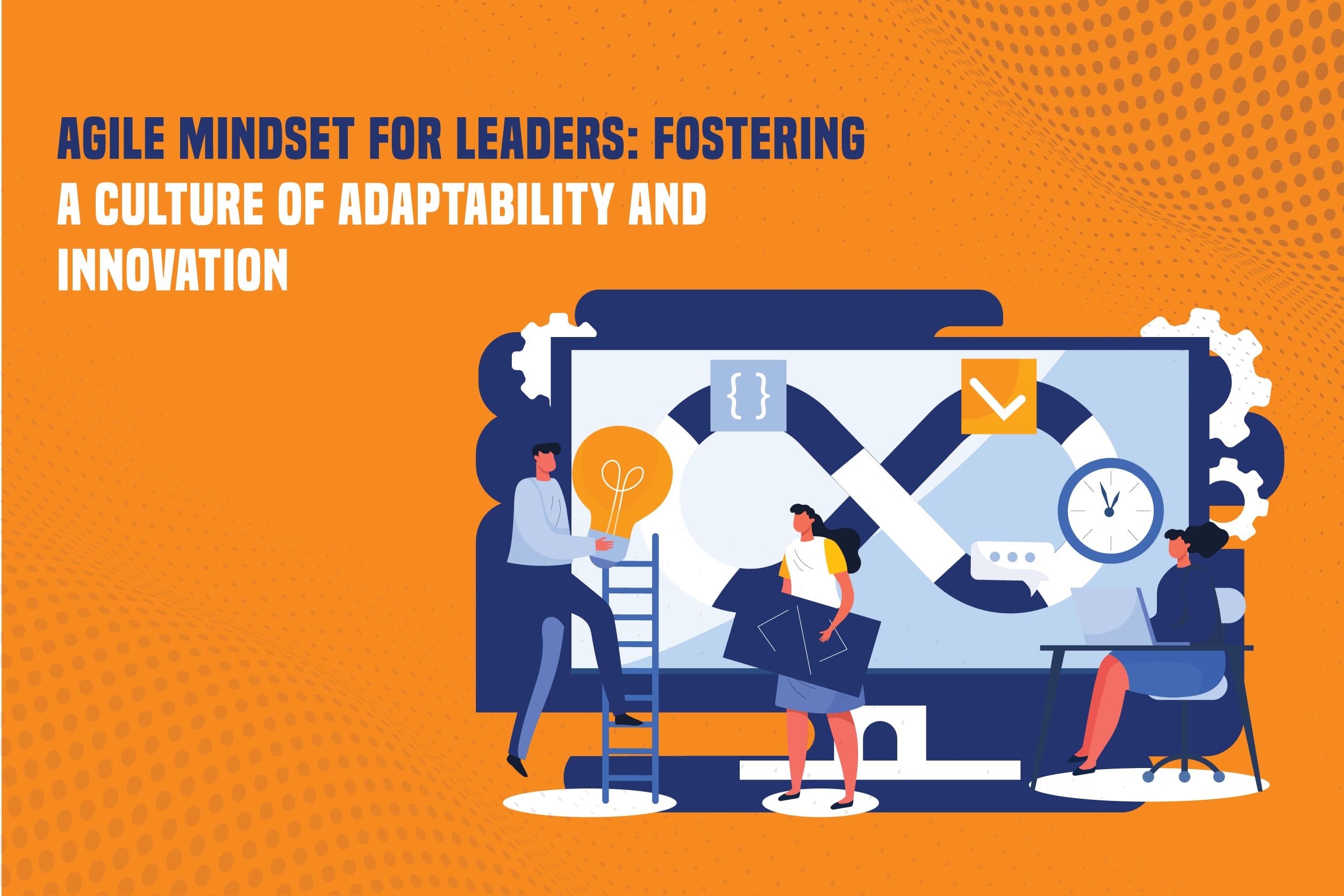
In the ever-evolving landscape of business and leadership, fostering an Agile Mindset among leaders is imperative for organizations to thrive. This mindset revolves around the principles of Agile Transformation, emphasizing adaptability, collaboration, and innovation as essential components of effective leadership.
Agile Transformation, a concept rooted in Agile methodology, transcends its application in project management and extends to shaping organizational culture and leadership approaches. An Agile Mindset for leaders involves embracing change, responding to uncertainty with resilience, and promoting a culture where innovation flourishes.
Leaders who embrace an Agile Mindset recognize that today’s fast-paced and unpredictable business environment often requires them to revise traditional, rigid structures and hierarchical management styles. Adaptability is a cornerstone of this mindset. Agile leaders comprehend that change is not merely a disruption; rather, it presents an opportunity for growth.ther, it is an opportunity for growth. They create a culture where teams are empowered to adapt swiftly to market shifts, customer needs, and unforeseen challenges. By fostering a mindset that embraces change, leaders contribute to the agility and responsiveness of the entire organization.
Leaders promoting Agile Transformation recognize that cross-functional teamwork and open communication are essential for success. This collaborative approach breaks down silos, encourages knowledge sharing, and enables diverse perspectives to contribute to problem-solving. In an Agile culture, leaders actively engage with team members, valuing their insights and fostering an environment where everyone feels heard and appreciated.
Agile Transformation is not just a set of practices but a mindset that leaders embody and champion throughout the organization. Therefore, it entails establishing an environment wherein teams feel empowered, motivated, and supported to deliver value swiftly and efficiently.
It positions the organization to navigate change effectively, stay ahead of the competition, and deliver value to customers consistently. Ultimately, adopting an Agile Mindset represents a strategic investment in the resilience, adaptability, and innovation capabilities essential for sustained success in the modern business world.
In the rapidly evolving landscape of the modern business world, leaders face the profound challenge of nurturing environments that thrive on adaptability and innovation. The Agile transformation, originating from software development, has transcended its initial purpose to become a guiding philosophy for leaders across diverse industries. This comprehensive blog delves deep into the essence of the Agile mindset. It provides an in-depth exploration of how leaders can proactively cultivate a culture that survives and excels in the face of constant change.
The Agile mindset is a collection of values and principles prioritizing flexibility, collaboration, and responsiveness to change. So, initially conceived as a project management methodology, Agile has proven effective in enabling teams to deliver value faster and more efficiently. However, its principles extend beyond project management, offering a comprehensive framework for an organizational culture that values iterative progress over rigid planning.
Leaders must instill the belief that change is inevitable and a constant force driving progress. Agile leaders promote a culture where change is not feared but welcomed as an opportunity for growth. So, this mindset shift empowers teams to adapt swiftly to market dynamics, customer needs, and internal transformations. They view change as an inherent part of the journey of the organization. So, it helps to navigate uncertainties with resilience and agility.
Agile thrives on collaboration, emphasizing the importance of cross-functional teams working together towards a common goal. An IT solution consultant can leverage Agile principles to foster cooperation and deliver effective solutions. Leaders should actively break down silos, encouraging open communication and a shared understanding of objectives. This collaborative spirit enables quick decision-making and the ability to pivot when necessary. The interconnectedness of team members fosters a sense of collective ownership and responsibility.
The Agile mindset advocates for iterative progress, breaking down significant goals into smaller, achievable tasks. So, leaders should encourage their teams to regularly assess and reassess their strategies, embracing a continuous improvement ethos. This iterative approach enhances adaptability and fuels a culture of innovation by allowing for experimentation and learning from failures. So, the concept of ‘inspect and adapt’ becomes integral to organizational growth.
Cultivating an Agile Culture:
So, an Agile culture starts at the top. Leaders must embody the values they seek to instill in their teams. Leaders create a ripple effect throughout the organization by showcasing adaptability, openness to change, and a willingness to learn. So, This authenticity is vital to building trust and credibility among the employees in the organization. When leaders exemplify the principles of the Agile mindset, they become the catalysts for a cultural transformation.
Agile leaders empower their teams by trusting their knowledge and delegating decision-making authority to them. Agile leadership plays a crucial role in business transformation in empowering teams and driving successful change. Additionally, relying on groups to take ownership fosters a sense of responsibility and accountability, forcing them to deliver their best work. So, this empowerment leads to higher job satisfaction, increased morale, and a culture where individuals feel valued and heard.
Failure is an inherent part of the innovation process of the organization’s growth. So, agile leaders create a safe space where failure is viewed as an opportunity to learn rather than a setback. This psychological safety encourages creativity and risk-taking, essential components of an innovative culture. So, employees who feel secure in taking risks are more likely to push boundaries and contribute groundbreaking ideas.
While the Agile mindset is overarching, specific Agile practices can be implemented to facilitate adaptability. In addition, daily stand-up meetings, sprint planning sessions, and retrospectives enhance communication, transparency, and the ability to respond to change promptly. So, these practices build an Agile culture, providing a structured framework for teams to collaborate effectively.
Agile leaders are adept at navigating change and uncertainty of the organization. So, this adaptability is a strategic advantage in industries where disruption is the norm. By fostering a culture that embraces change, organizations become more resilient in facing unforeseen challenges. Moreover, ability to pivot swiftly in response to market shifts positions the organization as a dynamic and forward-thinking entity.
For an IT solution consultant, fostering a culture of innovation is essential in delivering cutting-edge solutions. The Agile mindset promotes a culture of continuous improvement and learning, paving the way for groundbreaking ideas and solutions. Leaders who prioritize innovation position their organizations as industry pioneers. So, a culture that fosters innovation meets current market demands and anticipates and shapes future trends.
An Agile culture emphasizes collaboration, trust, and individual contribution. In addition, this not only attracts top talent but also keeps employees engaged and motivated. When individuals feel their work matters and their ideas are valued, they are more likely to invest fully in their roles. Enhanced employee engagement translates into increased productivity and a workforce aligned with the organization’s goals.
As the business transformation continues to evolve, an Agile culture becomes not just a competitive advantage but a necessity for sustained success. So, leaders must adapt or risk stagnation in a world where the only constant is change. The Agile mindset offers a roadmap for leaders to navigate uncertainty and thrive in it. By fostering a culture of adaptability and innovation, organizations can position themselves as industry leaders, ready to face whatever challenges the future may hold. So, embracing the Agile mindset is not just a methodology; it’s a strategic imperative for leaders looking to lead their organizations into a dynamic and ever-changing future. For more information, visit our website.
Artificial intelligence is transforming how modern businesses operate. From automating workflows to generating insights from massive datasets, AI offers organizations unprecedented opportunities to innovate and scale. However, as AI capabilities grow, so do concerns around ethics, accountability, and transparency. This is why responsible AI has become a critical priority for large organizations.
Read More
Digital transformation has become a strategic priority for organizations across industries. Businesses are investing in advanced technologies, data platforms, and automation tools to improve efficiency and remain competitive in an increasingly digital world. However, transformation initiatives are rarely simple. Many organizations underestimate the complexity of change, leading to delays, wasted investments, or stalled projects.
Read More
For many organizations, legacy systems are both a foundation and a barrier. These older technologies once powered growth, managed operations, and supported critical business functions. Over time, however, they often become difficult to maintain, expensive to update, and incompatible with modern tools. As markets evolve and customer expectations rise, businesses increasingly recognize the need for legacy modernization.
Read More
Digital transformation promises speed, innovation, and competitive advantage. Yet, despite heavy investments in new technologies, many organizations struggle to achieve meaningful results. In fact, digital transformation failure is more common than most companies expect. Businesses launch ambitious initiatives to modernize systems, adopt AI, or improve customer experiences, but somewhere along the way, momentum fades.
Understanding why digital transformations fail requires looking beyond technology. The real problems often lie in strategy, culture, leadership, and execution. When these elements are misaligned, even the most advanced tools cannot deliver transformation.
Below are some of the most common enterprise transformation challenges that cause digital initiatives to stall or collapse.
Read More
Artificial intelligence is quickly moving from experimentation to enterprise-wide implementation. Many organizations have already tested AI through pilot projects, automation tools, or analytics platforms. The next step—scaling AI across the organization—promises greater efficiency, smarter decision-making, and new business opportunities.
However, expanding AI initiatives without the right structure can create confusion rather than progress. Disconnected tools, unclear governance, and untrained teams often turn promising projects into operational headaches. For companies pursuing enterprise AI adoption, the real challenge is learning how to scale AI safely while maintaining control, consistency, and trust.
Successfully scaling AI requires thoughtful planning, strong governance, and a focus on people as much as technology.
Read More
Businesses evolve constantly. Markets change, customer expectations rise, and new technologies reshape how companies operate. To keep up, organizations often need more than new tools or strategies—they need to rethink how the entire business functions. This is where operating model transformation comes in.
While the phrase may sound complex, the concept is actually quite simple. It is about redesigning how a company works so that it can deliver value more efficiently, adapt faster, and support long-term growth.
Understanding what is an operating model transformation helps leaders make better decisions about people, processes, and technology.
Read More
Enterprise transformations are complex, high-stakes initiatives that often promise operational efficiency, digital modernization, and competitive advantage. Yet, despite meticulous planning and substantial investments, many transformation programs stumble—not because of technology, but because of people.
This is where change management becomes critical. Understanding why people resist change and applying effective strategies in transformation leadership can make the difference between a stalled project and a successful enterprise-wide transformation.
Read More
Artificial Intelligence (AI) is no longer a futuristic concept; it has become a cornerstone of modern business strategy. From automating routine tasks to generating insights from vast datasets, AI promises efficiency, innovation, and competitive advantage.
Yet, the rapid pace of AI adoption also brings uncertainty. Many executives struggle with defining their role in AI strategy, leading to stalled projects or missed opportunities. Understanding how leaders should think about Artificial Intelligence is essential for turning technology into tangible business outcomes.
Read More
Digital transformation is no longer just a buzzword—it’s a necessity for businesses aiming to stay competitive in today’s fast-paced market. Organizations invest in cloud technologies, automation, AI, and customer-centric platforms to modernize operations and create value. But with so many initiatives underway, one pressing question arises: how to measure transformation success? Without clear metrics, companies risk investing heavily without knowing whether their efforts are truly paying off.
Measuring success in digital transformation goes beyond counting deployed tools or completed projects. It requires tracking meaningful indicators that reflect actual business outcomes, employee adoption, and customer impact. Defining transformation KPIs early in the journey ensures that initiatives stay aligned with strategic goals and deliver measurable value.
Read More
Enterprise transformation is no longer a niche service—it has become a critical driver for organizations seeking growth, agility, and resilience. Businesses today face unprecedented challenges: rapidly evolving technologies, shifting customer expectations, and complex global markets. In response, transformation consulting has evolved from offering generic recommendations to delivering highly specialized, strategic guidance that helps enterprises navigate this dynamic landscape.
Understanding how consulting is changing provides insights into what the future of enterprise transformation consulting looks like, and why companies are increasingly relying on experts to guide their transformational journeys.
Read More

Leave a Reply