
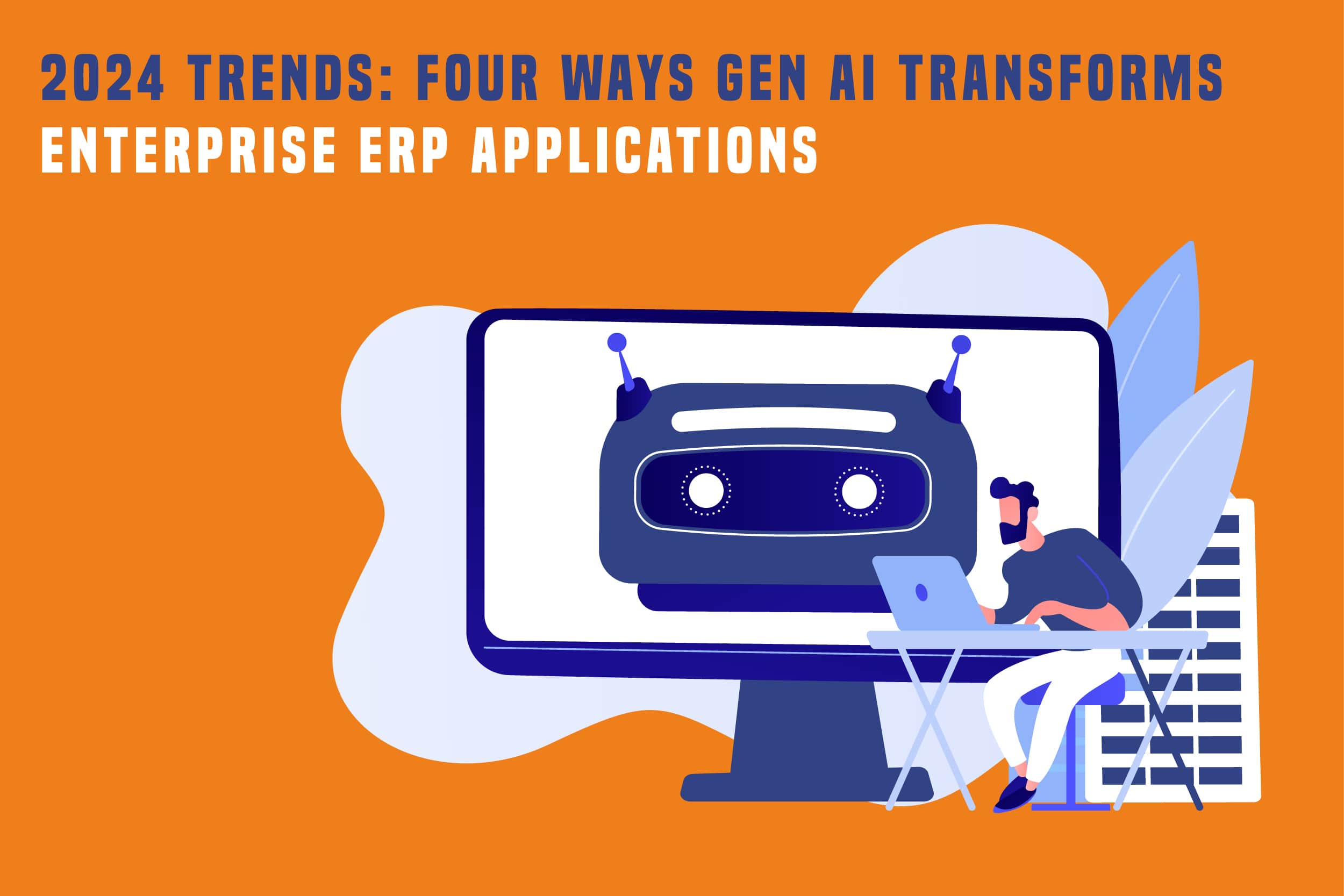
In the fast-evolving landscape of enterprise technology, the year 2024 witnesses a transformative wave with the integration of Generation AI (GenAI) into Enterprise Resource Planning (ERP) applications. The synergy between cutting-edge artificial intelligence and the foundational ERP systems marks not only an evolution but also a profound revolution.
Firstly, GenAI is ushering in a new era of efficiency through intelligent automation. Traditional ERP systems often rely on manual processes, leading to inefficiencies, errors, and increased costs. GenAI’s advanced machine learning algorithms and natural language processing capabilities bring forth intelligent automation, streamlining workflows and optimizing operational processes.
The second transformative trend lies in predictive analytics, providing organizations with the power of foresight. Traditional ERP systems, while adept at providing insights into past performance, often lacked the capability to accurately forecast future trends.. GenAI changes this narrative by leveraging predictive analytics to empower organizations with anticipatory decision-making.
Enhancing user experience emerges as the third significant trend through the incorporation of Natural Language Processing (NLP). Although traditional ERP systems excel at providing insights into past performance, they frequently lack the capability to accurately forecast future trends. GenAI addresses this by introducing NLP capabilities, allowing users to interact with ERP applications using natural language queries.
The fourth and crucial trend revolves around adaptive security measures. In an era where data breaches and cyber threats pose significant risks, GenAI reinforces ERP applications with adaptive security. By identifying anomalies in user behavior and continuously learning from emerging threats, GenAI-driven security solutions proactively implement risk mitigation strategies. This ensures data protection, regulatory compliance, and a resilient defense against evolving cybersecurity challenges.
So, the year 2024 witnessed a revolution in ERP implementation driven by the transformative power of GenAI. From intelligent automation and predictive analytics to enhanced user experiences and adaptive security measures, the integration of GenAI into ERP applications unlocks unprecedented levels of efficiency, innovation, and agility.
As we step into the future, the transformative impact of artificial intelligence (AI) on enterprise solutions is more evident than ever. Historically viewed as complex and time-consuming endeavors, ERP implementation is undergoing a paradigm shift as organizations harness the power of AI. In 2024, Generation AI (GenAI) stands at the forefront of this revolution, reshaping the landscape of Enterprise Resource Planning (ERP) applications. In this comprehensive exploration, we delve into four key dimensions through which GenAI. It is fundamentally transforming ERP systems, paving the way for unprecedented efficiency, innovation, and adaptability.
Traditional ERP systems have long been the backbone of organizational processes, automating various functions to enhance efficiency. However, the introduction of GenAI takes automation to an entirely new level. With advanced machine learning algorithms and natural language processing capabilities, GenAI empowers ERP applications to automate a wide array of tasks intelligently, streamlining workflows and optimizing resource utilization.
GenAI brings a new era of efficiency by incorporating Robotic Process Automation into ERP applications. Mundane and repetitive tasks such as data entry, invoice processing, and order fulfillment. These are seamlessly handled by AI-driven bots, freeing up human resources for more strategic endeavors.
Unlike traditional automation, GenAI systems possess the ability to learn and adapt over time. By analyzing historical data and user interactions, these systems continuously refine their processes, improving accuracy and efficiency. This adaptive learning capability ensures that ERP applications evolve alongside the dynamic needs of the organization.
GenAI’s intelligent automation extends to providing real-time decision support. So, ERP applications leverage AI algorithms to analyze data instantaneously, enabling swift decision-making. So, the ability to make data-driven decisions in real-time enhances operational agility.
By automating routine tasks and minimizing errors, GenAI contributes to significant cost reductions. The integration of AI streamlines various business processes within an IT consulting services company. Operational excellence is achieved as AI-driven automation ensures consistency, accuracy, and speed, leading to a more streamlined and cost-effective business environment.
In the dynamic business landscape of 2024, organizations are under increasing pressure not only to react to market changes but also to anticipate them. GenAI empowers ERP applications with advanced predictive analytics capabilities, enabling businesses to forecast trends, identify opportunities, and mitigate risks before they materialize.
GenAI leverages vast amounts of historical and real-time data to conduct holistic analyses. This includes customer behaviors, market trends, and internal operational patterns. The result is a comprehensive understanding of the business ecosystem, allowing organizations to make strategic decisions based on foresight rather than hindsight.
Predictive analytics in ERP applications aid in resource optimization. Whether it’s workforce management, inventory planning, or production scheduling. So, GenAI provides insights into future demands, enabling organizations to allocate resources efficiently and stay ahead of market fluctuations.
Understanding and predicting customer preferences is crucial for businesses in the digital age. So, GenAI enables ERP systems to analyze customer data and predict behaviors, facilitating personalized experiences and targeted marketing strategies.
GenAI’s real-time monitoring capabilities provide continuous oversight during SAP implementation. It can detect anomalies in the data or project metrics, signaling potential risks as they emerge. Whether it’s market volatility, supply chain disruptions, or regulatory changes, businesses equipped with predictive analytics can navigate uncertainties more effectively.
User experience has long been a critical factor in the successful adoption of ERP systems. GenAI transforms the user interface by integrating Natural Language Processing (NLP), making interactions with ERP applications more intuitive and user-friendly.
GenAI enhances ERP user interfaces by incorporating conversational interfaces and chatbots. So, users can interact with the system using natural language, simplifying complex tasks and reducing the learning curve. This not only improves user satisfaction but also accelerates the adoption of ERP systems across the organization.
NLP capabilities contribute to better data accuracy and completeness by minimizing manual data entry errors. Users can communicate with the ERP system more naturally, reducing the likelihood of input mistakes. This not only enhances the reliability of data but also streamlines data-driven decision-making processes.
GenAI enables ERP applications to understand user preferences and tailor the interface accordingly. So, each user may have a unique way of interacting with the system, and NLP facilitates personalized experiences. In addition, it boosts user productivity and also fosters a more positive and engaging work environment.
In an era marked by increasing cyber threats and data breaches, GenAI reinforces the security architecture of ERP applications with adaptive and proactive measures.
For an IT consulting services company, ensuring robust cybersecurity is paramount in safeguarding sensitive data and mitigating potential risks. By continuously learning from patterns, these systems enhance their ability to prevent security breaches preemptively, protecting sensitive business data.
GenAI contributes to robust identity management and access control within ERP systems. Through AI-driven algorithms, organizations can ensure that only authorized personnel have access to sensitive data, reducing the risk of unauthorized data exposure or manipulation.
As data protection regulations become more stringent, GenAI aids organizations in maintaining compliance. By automating security protocols and adapting to evolving compliance requirements, ERP applications powered by GenAI provide a secure foundation for sensitive business information.
In the dynamic landscape of 2024, the fusion of GenAI with ERP applications is not merely an evolution; it’s a revolution. GenAI’s predictive analytics capabilities bring foresight into SAP implementation by analyzing historical and real-time data. The seamless integration of intelligent automation, predictive analytics, natural language processing, and adaptive security. So, it propels ERP systems into a new era of efficiency, innovation, and adaptability. Organizations that embrace these transformative trends position themselves not just to survive but to thrive in an ever-changing business environment. As we navigate the complexities of the digital age, the synergy between GenAI and ERP applications emerges as a beacon guiding enterprises toward a future. Where intelligent technologies reshape the very fabric of business operations. For more information, visit our website.
Artificial intelligence is transforming how modern businesses operate. From automating workflows to generating insights from massive datasets, AI offers organizations unprecedented opportunities to innovate and scale. However, as AI capabilities grow, so do concerns around ethics, accountability, and transparency. This is why responsible AI has become a critical priority for large organizations.
Read More
Digital transformation has become a strategic priority for organizations across industries. Businesses are investing in advanced technologies, data platforms, and automation tools to improve efficiency and remain competitive in an increasingly digital world. However, transformation initiatives are rarely simple. Many organizations underestimate the complexity of change, leading to delays, wasted investments, or stalled projects.
Read More
For many organizations, legacy systems are both a foundation and a barrier. These older technologies once powered growth, managed operations, and supported critical business functions. Over time, however, they often become difficult to maintain, expensive to update, and incompatible with modern tools. As markets evolve and customer expectations rise, businesses increasingly recognize the need for legacy modernization.
Read More
Digital transformation promises speed, innovation, and competitive advantage. Yet, despite heavy investments in new technologies, many organizations struggle to achieve meaningful results. In fact, digital transformation failure is more common than most companies expect. Businesses launch ambitious initiatives to modernize systems, adopt AI, or improve customer experiences, but somewhere along the way, momentum fades.
Understanding why digital transformations fail requires looking beyond technology. The real problems often lie in strategy, culture, leadership, and execution. When these elements are misaligned, even the most advanced tools cannot deliver transformation.
Below are some of the most common enterprise transformation challenges that cause digital initiatives to stall or collapse.
Read More
Artificial intelligence is quickly moving from experimentation to enterprise-wide implementation. Many organizations have already tested AI through pilot projects, automation tools, or analytics platforms. The next step—scaling AI across the organization—promises greater efficiency, smarter decision-making, and new business opportunities.
However, expanding AI initiatives without the right structure can create confusion rather than progress. Disconnected tools, unclear governance, and untrained teams often turn promising projects into operational headaches. For companies pursuing enterprise AI adoption, the real challenge is learning how to scale AI safely while maintaining control, consistency, and trust.
Successfully scaling AI requires thoughtful planning, strong governance, and a focus on people as much as technology.
Read More
Businesses evolve constantly. Markets change, customer expectations rise, and new technologies reshape how companies operate. To keep up, organizations often need more than new tools or strategies—they need to rethink how the entire business functions. This is where operating model transformation comes in.
While the phrase may sound complex, the concept is actually quite simple. It is about redesigning how a company works so that it can deliver value more efficiently, adapt faster, and support long-term growth.
Understanding what is an operating model transformation helps leaders make better decisions about people, processes, and technology.
Read More
Enterprise transformations are complex, high-stakes initiatives that often promise operational efficiency, digital modernization, and competitive advantage. Yet, despite meticulous planning and substantial investments, many transformation programs stumble—not because of technology, but because of people.
This is where change management becomes critical. Understanding why people resist change and applying effective strategies in transformation leadership can make the difference between a stalled project and a successful enterprise-wide transformation.
Read More
Artificial Intelligence (AI) is no longer a futuristic concept; it has become a cornerstone of modern business strategy. From automating routine tasks to generating insights from vast datasets, AI promises efficiency, innovation, and competitive advantage.
Yet, the rapid pace of AI adoption also brings uncertainty. Many executives struggle with defining their role in AI strategy, leading to stalled projects or missed opportunities. Understanding how leaders should think about Artificial Intelligence is essential for turning technology into tangible business outcomes.
Read More
Digital transformation is no longer just a buzzword—it’s a necessity for businesses aiming to stay competitive in today’s fast-paced market. Organizations invest in cloud technologies, automation, AI, and customer-centric platforms to modernize operations and create value. But with so many initiatives underway, one pressing question arises: how to measure transformation success? Without clear metrics, companies risk investing heavily without knowing whether their efforts are truly paying off.
Measuring success in digital transformation goes beyond counting deployed tools or completed projects. It requires tracking meaningful indicators that reflect actual business outcomes, employee adoption, and customer impact. Defining transformation KPIs early in the journey ensures that initiatives stay aligned with strategic goals and deliver measurable value.
Read More
Enterprise transformation is no longer a niche service—it has become a critical driver for organizations seeking growth, agility, and resilience. Businesses today face unprecedented challenges: rapidly evolving technologies, shifting customer expectations, and complex global markets. In response, transformation consulting has evolved from offering generic recommendations to delivering highly specialized, strategic guidance that helps enterprises navigate this dynamic landscape.
Understanding how consulting is changing provides insights into what the future of enterprise transformation consulting looks like, and why companies are increasingly relying on experts to guide their transformational journeys.
Read More

Leave a Reply