
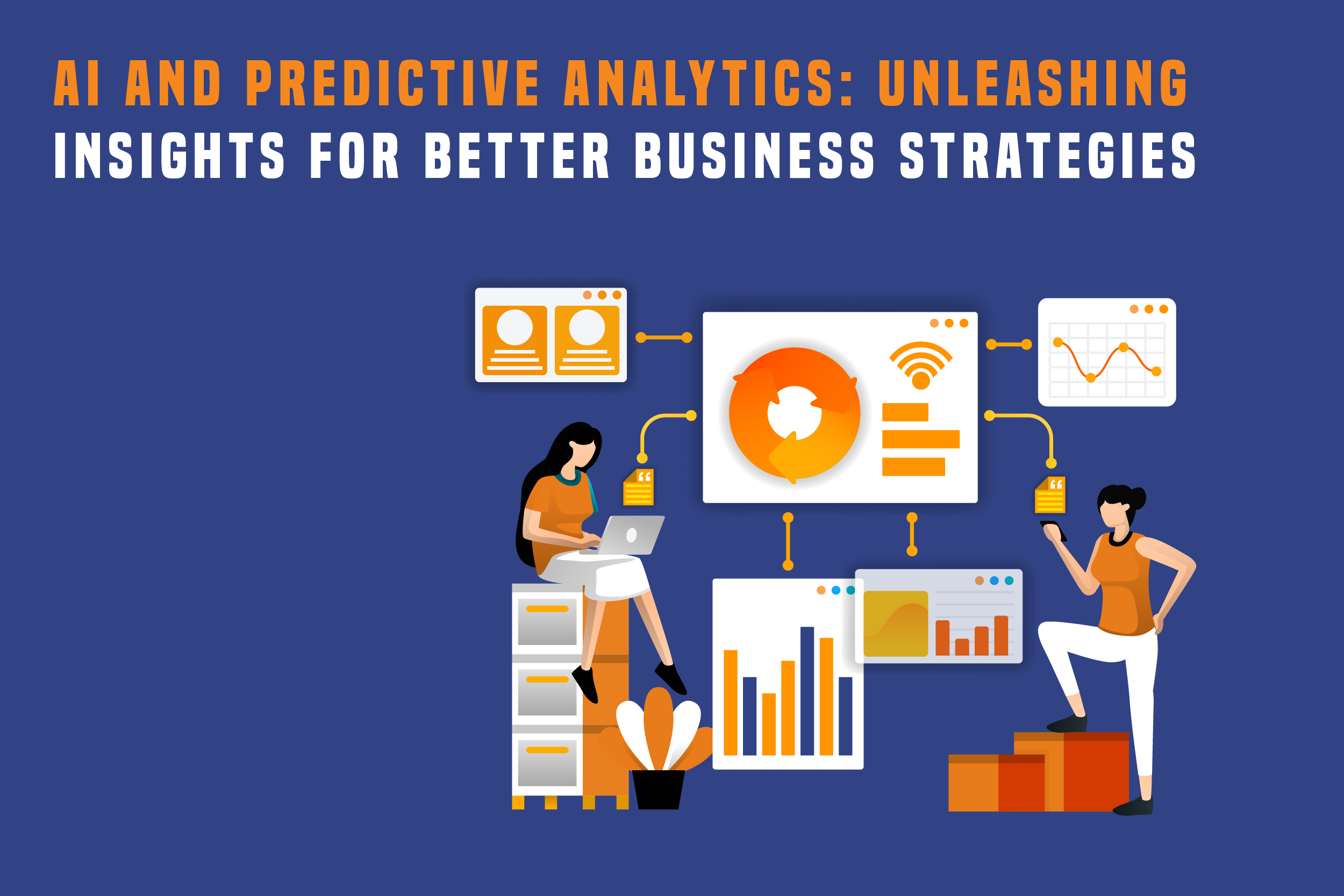
Artificial intelligence (AI) and predictive analytics synergy emerge as powerful catalysts for transforming business strategies in the era of data-driven decision-making. This dynamic duo not only unlocks valuable insights but also propels organizations into a realm of informed and proactive decision-making.
At the core of this transformative journey lies the ability to leverage AI to sift through vast datasets, discern patterns, and extract meaningful predictions. Predictive Analytics, in tandem with AI, enables businesses to anticipate trends, identify opportunities, and mitigate risks with unprecedented precision. So, a paradigm shift from reactive strategies to proactive, forward-thinking approaches. It can spell the difference between success and stagnation in today’s fast-paced business environment.
From optimizing operational efficiency to enhancing customer experiences, the insights derived empower organizations to stay ahead of the curve. Whether predicting market trends, anticipating customer needs, or streamlining supply chain operations, amalgamating. So, these technologies provide a comprehensive and holistic view of the business landscape.
Moreover, applying Artificial intelligence and Predictive Analytics is not confined to a specific industry. The transformative impact is universal, from finance and healthcare to retail and manufacturing. AI’s ability to learn and adapt, coupled with Predictive Analytics’ foresight, offers a tailored approach to address industry-specific challenges and opportunities.
Moreover, enhancing business strategies entails integrating AI and Predictive Analytics strategically into current workflows to unlock valuable insights. It’s about empowering teams with the tools and knowledge to harness the full potential of these technologies. Creating a culture that embraces data-driven decisions is crucial; AI and Predictive Analytics thrive when integrated into the organizational DNA..
So, it’s a fundamental shift in how businesses perceive, interpret, and act on data. It’s a journey towards a future where insights gleaned from these technologies serve as the compass guiding organizations to unparalleled success and competitiveness in the ever-evolving business landscape.
Businesses today have powerful tools to gain important insights from massive volumes of data, thanks to the development of Artificial Intelligence (AI) and predictive analytics. This blog investigates the relationship between AI and predictive analytics, demonstrating how these technologies change how firms strategize and make educated decisions.
Statistical algorithms and machine learning techniques are used in predictive analytics to analyze previous data and forecast future occurrences. Businesses may foresee outcomes, detect possible hazards, and make proactive choices by exploiting data patterns and trends. This is especially important in a commercial world where the only constant is unpredictability.
AI plays a significant role in predictive analytics by leveraging advanced algorithms and machine learning techniques to analyze historical data, identify patterns, and predict future events. Here are vital aspects of the role of AI in predictive analytics:
AI systems can handle vast amounts of data, including structured and unstructured data from various sources. So, this capability allows organizations to analyze historical data comprehensively.
Machine learning algorithms can automatically identify patterns, trends, and correlations within the data that may not be apparent through traditional analysis methods.
As an IT solution consultant, leveraging AI models for feature selection can offer several advantages in enhancing the overall performance analytics solutions. So, this helps in optimizing models and avoiding overfitting objects in the organization.
Feature engineering, which involves creating new features from existing data, can be automated by AI to enhance the predictive power of models.
AI enables the development of complex predictive models through machine learning algorithms such as regression, decision trees, random forests, and neural networks.
Automated model training allows the system to continuously learn and adapt to changing patterns in data over time. Hyperparameter tuning and model optimization can be performed more efficiently with the help of AI algorithms.
AI facilitates the implementation of predictive models in real-time scenarios, enabling organizations. It helps to make instant decisions based on the most up-to-date information.
This is particularly crucial in finance, healthcare, and manufacturing industries, where timely predictions can significantly impact.
In addition, AI algorithms excel at detecting anomalies or outliers in data of the organization. This capability is valuable for identifying unusual patterns that may indicate potential issues, fraud, or opportunities.
Anomaly detection is essential for predictive maintenance in industries where early detection of equipment failures can prevent costly downtime.
Consider a retail business utilizing AI-driven predictive analytics to forecast customer demand. So, traditional methods might rely on historical sales data and fundamental trends. In contrast, AI algorithms can factor in many variables, such as social media trends, economic indicators, and weather patterns. This holistic approach results in more accurate demand forecasts, reducing the risk of overstock or stockouts.
So, AI-driven predictive analytics enables businesses to understand customer behavior and preferences on an individual level. This information is invaluable for crafting personalized marketing campaigns that resonate with specific target audiences. Companies can significantly improve customer engagement and conversion rates by delivering tailored messages and offers.
Leveraging businesses can reduce costs by using IT consulting services to optimize inventory management processes. So, It enhances customer satisfaction and achieves better overall financial performance.
AI-powered predictive analytics helps businesses optimize inventory levels by predicting demand fluctuations, identifying slow-moving items, and reducing the likelihood of stockouts.
In the financial sector, AI and predictive analytics are instrumental in detecting fraudulent activities and managing risks. Advanced algorithms analyze transaction patterns, identify anomalies, and alert businesses. It helps to prevent potential fraudulent behavior in real-time, safeguarding financial assets.
While AI plays a crucial role in predictive analytics, organizations must address several challenges and considerations to maximize the effectiveness of their predictive analytics initiatives. Here are some key challenges and concerns that are discussed below:
Predictive analytics heavily relies on the quality and availability of data of the organization. So, organizations may face challenges obtaining high-quality, relevant, and up-to-date data from diverse sources.
As an IT solution consultant, your role is crucial in helping organizations implement robust measures to protect sensitive information. Organizations must comply with regulations and implement robust security measures to safeguard the confidentiality of data used in predictive analytics.
Many advanced AI models, such as intense neural networks, are often considered “black box” models, making it challenging to interpret their decisions. Understanding the logic behind predictions is crucial, especially in industries with regulatory requirements or where human decision-making is involved.
AI models can inherit biases present in historical data, leading to biased predictions. Ensuring fairness and addressing discrimination in predictive models is essential, particularly in applications like finance, hiring, and healthcare, where personal predictions can have significant societal impacts.
Overfitting happens when a model is very complicated and overly closely matches the training data, resulting in poor generalization to new, unknown data. Regularization techniques and proper model validation are essential to mitigate overfitting.
By offering comprehensive IT consulting services in these areas, you can guide businesses through adopting AI and predictive analytics. By harnessing the power of these technologies, organizations can unlock valuable insights, streamline operations, and make informed decisions that impact their bottom line positively. As the symbiotic relationship between AI and predictive analytics continues to evolve, businesses. So, embracing these technologies will undoubtedly be better positioned to thrive in the ever-changing global market landscape. For more information, visit our website.
Artificial intelligence is transforming how modern businesses operate. From automating workflows to generating insights from massive datasets, AI offers organizations unprecedented opportunities to innovate and scale. However, as AI capabilities grow, so do concerns around ethics, accountability, and transparency. This is why responsible AI has become a critical priority for large organizations.
Read More
Digital transformation has become a strategic priority for organizations across industries. Businesses are investing in advanced technologies, data platforms, and automation tools to improve efficiency and remain competitive in an increasingly digital world. However, transformation initiatives are rarely simple. Many organizations underestimate the complexity of change, leading to delays, wasted investments, or stalled projects.
Read More
For many organizations, legacy systems are both a foundation and a barrier. These older technologies once powered growth, managed operations, and supported critical business functions. Over time, however, they often become difficult to maintain, expensive to update, and incompatible with modern tools. As markets evolve and customer expectations rise, businesses increasingly recognize the need for legacy modernization.
Read More
Digital transformation promises speed, innovation, and competitive advantage. Yet, despite heavy investments in new technologies, many organizations struggle to achieve meaningful results. In fact, digital transformation failure is more common than most companies expect. Businesses launch ambitious initiatives to modernize systems, adopt AI, or improve customer experiences, but somewhere along the way, momentum fades.
Understanding why digital transformations fail requires looking beyond technology. The real problems often lie in strategy, culture, leadership, and execution. When these elements are misaligned, even the most advanced tools cannot deliver transformation.
Below are some of the most common enterprise transformation challenges that cause digital initiatives to stall or collapse.
Read More
Artificial intelligence is quickly moving from experimentation to enterprise-wide implementation. Many organizations have already tested AI through pilot projects, automation tools, or analytics platforms. The next step—scaling AI across the organization—promises greater efficiency, smarter decision-making, and new business opportunities.
However, expanding AI initiatives without the right structure can create confusion rather than progress. Disconnected tools, unclear governance, and untrained teams often turn promising projects into operational headaches. For companies pursuing enterprise AI adoption, the real challenge is learning how to scale AI safely while maintaining control, consistency, and trust.
Successfully scaling AI requires thoughtful planning, strong governance, and a focus on people as much as technology.
Read More
Businesses evolve constantly. Markets change, customer expectations rise, and new technologies reshape how companies operate. To keep up, organizations often need more than new tools or strategies—they need to rethink how the entire business functions. This is where operating model transformation comes in.
While the phrase may sound complex, the concept is actually quite simple. It is about redesigning how a company works so that it can deliver value more efficiently, adapt faster, and support long-term growth.
Understanding what is an operating model transformation helps leaders make better decisions about people, processes, and technology.
Read More
Enterprise transformations are complex, high-stakes initiatives that often promise operational efficiency, digital modernization, and competitive advantage. Yet, despite meticulous planning and substantial investments, many transformation programs stumble—not because of technology, but because of people.
This is where change management becomes critical. Understanding why people resist change and applying effective strategies in transformation leadership can make the difference between a stalled project and a successful enterprise-wide transformation.
Read More
Artificial Intelligence (AI) is no longer a futuristic concept; it has become a cornerstone of modern business strategy. From automating routine tasks to generating insights from vast datasets, AI promises efficiency, innovation, and competitive advantage.
Yet, the rapid pace of AI adoption also brings uncertainty. Many executives struggle with defining their role in AI strategy, leading to stalled projects or missed opportunities. Understanding how leaders should think about Artificial Intelligence is essential for turning technology into tangible business outcomes.
Read More
Digital transformation is no longer just a buzzword—it’s a necessity for businesses aiming to stay competitive in today’s fast-paced market. Organizations invest in cloud technologies, automation, AI, and customer-centric platforms to modernize operations and create value. But with so many initiatives underway, one pressing question arises: how to measure transformation success? Without clear metrics, companies risk investing heavily without knowing whether their efforts are truly paying off.
Measuring success in digital transformation goes beyond counting deployed tools or completed projects. It requires tracking meaningful indicators that reflect actual business outcomes, employee adoption, and customer impact. Defining transformation KPIs early in the journey ensures that initiatives stay aligned with strategic goals and deliver measurable value.
Read More
Enterprise transformation is no longer a niche service—it has become a critical driver for organizations seeking growth, agility, and resilience. Businesses today face unprecedented challenges: rapidly evolving technologies, shifting customer expectations, and complex global markets. In response, transformation consulting has evolved from offering generic recommendations to delivering highly specialized, strategic guidance that helps enterprises navigate this dynamic landscape.
Understanding how consulting is changing provides insights into what the future of enterprise transformation consulting looks like, and why companies are increasingly relying on experts to guide their transformational journeys.
Read More

Leave a Reply