
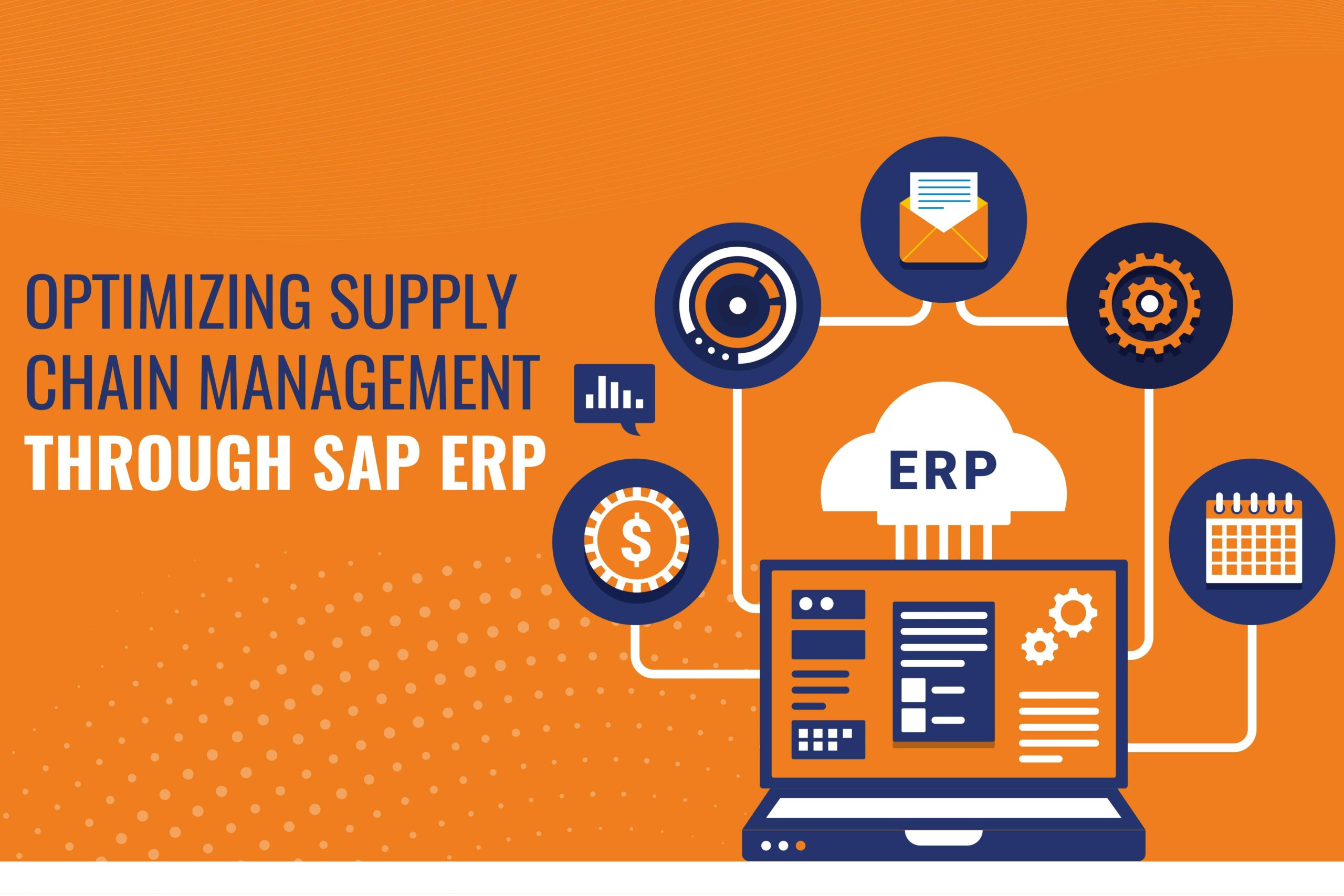
Optimizing Supply Chain Management through SAP ERP with SAP consulting services can significantly enhance operational efficiency and streamline business processes. SAP ERP (Enterprise Resource Planning) is a comprehensive software solution that integrates various aspects of a company’s operations, including finance, inventory, production, and procurement, into a single system. It becomes a powerful tool for improving supply chain management when coupled with expert SAP consulting services.
SAP ERP offers real-time visibility into inventory levels, demand forecasting, and order processing. This visibility enables businesses to make informed decisions, reduce excess inventory, and minimize stockouts. SAP consulting services are crucial in configuring the ERP system to meet specific business needs, ensuring a tailored solution that optimally aligns with the supply chain strategy. SAP ERP also enhances collaboration with suppliers and customers through its Supplier Relationship Management (SRM) and Customer Relationship Management (CRM) modules. This helps build stronger relationships, improve communication, and ultimately increase supply chain efficiency.
Furthermore, SAP’s advanced analytics and reporting capabilities enable data-driven decision-making. With the support of SAP consulting services, organizations can develop custom reports and dashboards to monitor key performance indicators (KPIs) and track supply chain metrics. This data-driven approach allows for proactively identifying issues and bottlenecks, leading to faster problem resolution and improved overall supply chain performance.
Automation is another significant benefit of SAP ERP in supply chain management. Routine tasks such as order processing, invoice generation, and inventory automation updates reduce manual errors and free up valuable human resources for more strategic activities.Therefore, leveraging SAP ERP with the assistance of SAP consulting services is a powerful strategy for optimizing supply chain management. It enables businesses to gain real-time visibility, enhance collaboration, make data-driven decisions, and automate critical processes. By harnessing these capabilities, organizations can streamline their supply chain operations, reduce costs, and gain a competitive edge in today’s dynamic business environment.
Supply chain management is essential to corporate performance in an era characterized by globalization, quick technological change, and rising customer expectations. This recognition has led to a growing emphasis on ERP implementation as a critical strategy for optimizing supply chain operations. If your supply chain is well-managed, it may be the difference between succeeding in a cutthroat industry and struggling to satisfy client expectations. Modern businesses looking to optimize their supply chains have one of the most effective tools in SAP ERP.
This blog explores the field of supply chain management and examines how SAP ERP acts as a revolutionary force for improving supply chain operations. Its core resource and process management function is its practical applications across sectors.
Optimizing supply chain management is the process of strategically and methodically enhancing the efficacy, efficiency, and general performance of a company’s supply chain. The actions, procedures, and connections in locating, manufacturing, and distributing goods or services to clients are collectively called the supply chain.
Cut back on all operational and logistical expenses along the supply chain, such as manufacturing, shipping, and inventory keeping.
SAP ERP is a comprehensive software solution that integrates various aspects of a company’s operations into a unified system. It covers everything from financials and inventory management to production planning and procurement. When we can use it effectively, SAP implementation can significantly enhance supply chain management in several ways:
One of the key benefits of SAP ERP is its ability to provide real-time visibility into various aspects of the supply chain. This includes inventory levels, order status, and demand forecasting. With this real-time data, businesses can make informed decisions quickly. For example, they can adjust production schedules to meet changing demand or reorder inventory before stockouts occur.
SAP ERP includes robust demand forecasting capabilities, allowing businesses to predict future demand patterns more accurately. This helps in optimizing inventory levels and preventing overstock or understock situations. Organizations can fine-tune these forecasting models with SAP consulting services to align with their unique business needs.
Collaboration with suppliers is critical for a smooth supply chain operation. SAP ERP’s SRM module helps businesses manage their relationships with suppliers effectively. It facilitates communication, streamlines procurement processes, and ensures that suitable materials are available when needed.
: As with suppliers, maintaining solid customer relationships is vital. SAP ERP’s CRM module enables businesses to understand customers’ needs, track interactions better, and provide superior customer service. This helps in building loyalty and ensuring that customer demands are met efficiently.
Data is a powerful tool in supply chain optimization. SAP ERP offers advanced analytics and reporting capabilities, allowing organizations to analyze key performance indicators (KPIs) and track supply chain metrics. So, custom reports and dashboards are created with the assistance of SAP consulting services, enabling proactive issue identification and quicker problem resolution.
Routine tasks, such as order processing, invoice generation, and inventory updates, can be automated within SAP ERP. This reduces the risk of manual errors and frees up valuable human resources for more strategic activities.
By leveraging SAP ERP implementation with the assistance of SAP consulting services, organizations can achieve a wide range of benefits in supply chain management:
Optimized supply chain processes result in cost savings. Businesses can reduce excess inventory, minimize stockouts, and streamline procurement, reducing operational costs.
Improved communication with suppliers and customers leads to stronger relationships and greater supply chain efficiency. This collaboration can result in better pricing, faster deliveries, and increased customer satisfaction.
Accessing real-time data and customized reports allows for data-driven decision-making. This proactive approach helps identify issues and bottlenecks faster, improving supply chain performance.
Automation of routine tasks reduces manual errors and frees up employees for more strategic activities. This efficiency can lead to faster order processing and reduced administrative overhead.
Organizations that optimize their supply chains through SAP ERP gain a competitive edge. They can respond more quickly to market changes, deliver products faster, and meet customer demands more effectively.
An optimized supply chain is more resilient and adaptable to supply chain disruptions and changing customer preferences. It can quickly pivot to address new challenges and opportunities.
So, Optimizing supply chain management through SAP ERP with the assistance of SAP implementation is a powerful strategy for businesses looking to gain a competitive edge in today’s dynamic business environment. Integrating various supply chain components, real-time visibility, demand forecasting, collaboration with suppliers and customers, advanced analytics, and process automation contribute to a more efficient and responsive supply chain.
Enterprise transformations are complex, high-stakes initiatives that often promise operational efficiency, digital modernization, and competitive advantage. Yet, despite meticulous planning and substantial investments, many transformation programs stumble—not because of technology, but because of people.
This is where change management becomes critical. Understanding why people resist change and applying effective strategies in transformation leadership can make the difference between a stalled project and a successful enterprise-wide transformation.
Read More
Artificial Intelligence (AI) is no longer a futuristic concept; it has become a cornerstone of modern business strategy. From automating routine tasks to generating insights from vast datasets, AI promises efficiency, innovation, and competitive advantage.
Yet, the rapid pace of AI adoption also brings uncertainty. Many executives struggle with defining their role in AI strategy, leading to stalled projects or missed opportunities. Understanding how leaders should think about AI is essential for turning technology into tangible business outcomes.
Read More
Digital transformation is no longer just a buzzword—it’s a necessity for businesses aiming to stay competitive in today’s fast-paced market. Organizations invest in cloud technologies, automation, AI, and customer-centric platforms to modernize operations and create value. But with so many initiatives underway, one pressing question arises: how to measure transformation success? Without clear metrics, companies risk investing heavily without knowing whether their efforts are truly paying off.
Measuring success in digital transformation goes beyond counting deployed tools or completed projects. It requires tracking meaningful indicators that reflect actual business outcomes, employee adoption, and customer impact. Defining transformation KPIs early in the journey ensures that initiatives stay aligned with strategic goals and deliver measurable value.
Read More
Enterprise transformation is no longer a niche service—it has become a critical driver for organizations seeking growth, agility, and resilience. Businesses today face unprecedented challenges: rapidly evolving technologies, shifting customer expectations, and complex global markets. In response, transformation consulting has evolved from offering generic recommendations to delivering highly specialized, strategic guidance that helps enterprises navigate this dynamic landscape.
Understanding how consulting is changing provides insights into what the future of enterprise transformation consulting looks like, and why companies are increasingly relying on experts to guide their transformational journeys.
Read More
Artificial intelligence is quickly moving from experimentation to real business impact. Organizations are using AI to automate decisions, improve customer experiences, and extract insights from massive volumes of data. However, simply adopting AI tools does not guarantee success. Many companies discover that their existing workflows were never designed to support intelligent automation.
To unlock the full potential of AI, businesses must rethink how their processes are structured. This is where business process transformation becomes essential. Organizations need AI-ready processes that are structured, data-driven, and adaptable. Without these foundations, even the most advanced AI systems struggle to deliver value.
Understanding how to prepare processes for AI helps businesses build systems that are not only efficient today but also capable of evolving with future technologies.
Read More
Businesses today are under constant pressure to move faster, operate efficiently, and deliver better customer experiences. In response, many organizations invest in automation tools and digital technologies. However, a common misunderstanding arises when companies assume automation alone equals transformation.
In reality, automation vs transformation is not a comparison of competing strategies. Instead, automation is a component of digital transformation, not the transformation itself. Understanding this distinction is essential for organizations that want to achieve meaningful and lasting change.
When leaders realize that automation is not digital transformation, they can approach technology adoption more strategically and avoid investing in tools that produce only limited impact.
Read More
In today’s fast-paced business landscape, uncertainty is the only constant. From global economic shifts to rapid technological change, organizations face pressures that can disrupt operations, challenge growth, and threaten survival. In this environment, organizational resilience is no longer optional—it is essential. Companies that cultivate adaptability, foresight, and responsiveness are better equipped to thrive, even under the most challenging circumstances.
How companies stay resilient begins with a mindset that sees disruption not as a threat, but as an opportunity to learn, evolve, and innovate. Resilient organizations do more than recover from setbacks—they anticipate challenges, respond effectively, and emerge stronger.
Read More
In today’s fast-paced digital landscape, businesses must adapt to changing technologies and customer expectations to remain competitive. One of the most effective ways to achieve this adaptability is through digital transformation, which involves integrating digital technologies into all areas of a business. A critical component of this transformation is Enterprise Resource Planning (ERP) systems.
Read More
Implementing an SAP system can be a transformative step for organizations aiming to enhance their operational efficiency, streamline processes, and improve data visibility. However, success in an SAP implementation goes beyond simply completing the project on time and within budget. It involves measuring and analyzing key performance metrics that provide insight into how effectively the system is being utilized and whether it meets the organization’s objectives.
Read More
In today’s fast-paced business environment, efficient systems and processes are vital for success. Enterprise Resource Planning (ERP) systems like SAP are central to this, helping organizations streamline their operations, manage resources more effectively, and drive productivity.
However, ERP implementation is a complex and often challenging process that requires a skilled IT consulting partner to ensure success. Selecting the right IT consulting services for your ERP implementation, especially for SAP, can make the difference between seamless integration and costly disruptions.
Read More
Leave a Reply