
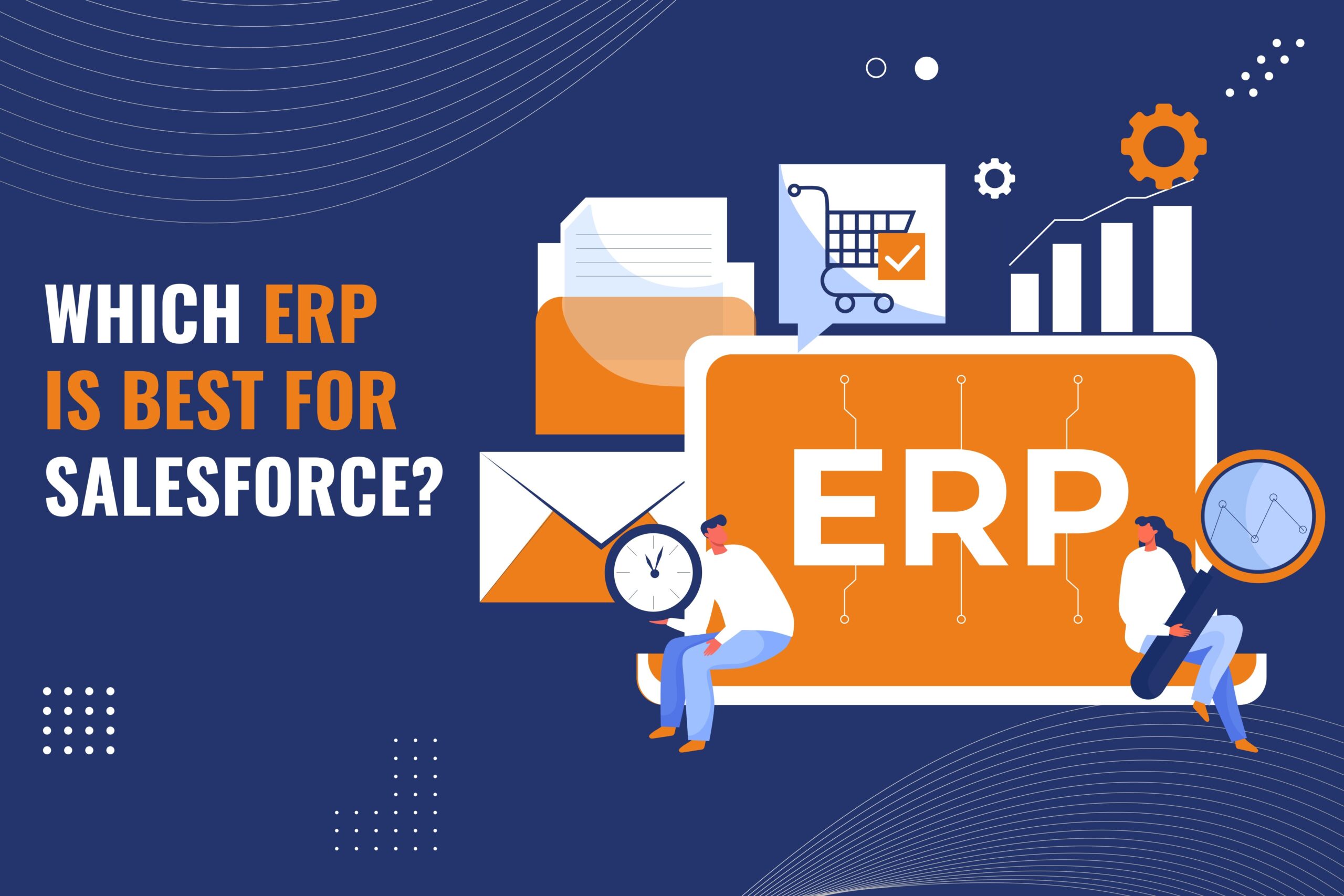
Each system has distinctive features and advantages, making it necessary to assess your business requirements before making a choice. Integrating an ERP system with Salesforce can propel your business towards greater achievements and expansion.
Salesforce is a powerful customer relationship management (CRM) tool that helps businesses manage customer data, track sales leads, and improve customer satisfaction. However, integrating an enterprise resource planning (ERP) system can take your business to the next level by streamlining operations, reducing costs, and improving efficiency. The right ERP implementation for Salesforce can provide a comprehensive platform for managing financials, inventory, and supply chain processes. In this blog, we will explore the best ERP systems for Salesforce and how they can benefit your business. Before that let us understand what an ERP is.
ERP stands for Enterprise Resource Planning. It is a type of business software that integrates all aspects of a company’s operations, including finance, human resources, procurement, inventory management, supply chain management, and customer relationship management. It helps organizations manage and automate their business processes across departments and functions. ERP systems streamline processes by automating routine tasks, reducing manual data entry, and enabling better collaboration between departments. They provide a single source of truth for business data, allowing companies to make better decisions and improve efficiency and profitability. This further improves the SAP
Salesforce is software for customer relationship management (CRM) that operates in the cloud, providing assistance to businesses in managing sales, marketing, and customer service operations. The platform offers a set of tools and applications that automate business processes, analyze customer data, and enhance collaboration among teams.
By utilizing Salesforce, businesses can easily manage customer information, track sales leads, design marketing campaigns, and deliver customized customer support. The software is highly adaptable, enabling businesses to tailor their CRM solutions to their specific requirements. Salesforce is designed to have a user-friendly interface and mobile applications, allowing easy accessibility from anywhere. The software is scalable, and suitable for small businesses and large enterprises alike.
In conclusion, Salesforce is among the most favored CRM solutions, with millions of users worldwide. Its flexible features, ease of use, and robust capabilities make it an advantageous tool for businesses across all sectors and sizes.
Prioritizing features such as usability, scalability, and practicality when integrating with Salesforce is critical, whether it’s Oracle, SAP, Microsoft Dynamics, or any other well-known ERP vendor. Additionally, engaging various stakeholders from different departments is vital to gather feedback and ensure that the preferred ERP aligns with the overall business strategy. Ultimately, there is no universal answer to the question of which ERP is the best fit for Salesforce, and the decision requires a strategic approach that involves a thorough research and careful consideration of the unique demands of each company.
There are the best choices of ERP for Salesforce which are discussed below.
Integrating an ERP system with Salesforce can propel your business towards greater achievements and better ERP Implementation. To sum up, determining the most suitable ERP system for Salesforce primarily hinges on the specific requirements and objectives of each company. Although there are notable contenders that offer notable integrations and customized functionalities for Salesforce users, selecting an ERP entails a meticulous assessment of factors like business size, industry, budget, and IT infrastructure.
Digital transformation promises speed, innovation, and competitive advantage. Yet, despite heavy investments in new technologies, many organizations struggle to achieve meaningful results. In fact, digital transformation failure is more common than most companies expect. Businesses launch ambitious initiatives to modernize systems, adopt AI, or improve customer experiences, but somewhere along the way, momentum fades.
Understanding why digital transformations fail requires looking beyond technology. The real problems often lie in strategy, culture, leadership, and execution. When these elements are misaligned, even the most advanced tools cannot deliver transformation.
Below are some of the most common enterprise transformation challenges that cause digital initiatives to stall or collapse.
Read More
Artificial intelligence is quickly moving from experimentation to enterprise-wide implementation. Many organizations have already tested AI through pilot projects, automation tools, or analytics platforms. The next step—scaling AI across the organization—promises greater efficiency, smarter decision-making, and new business opportunities.
However, expanding AI initiatives without the right structure can create confusion rather than progress. Disconnected tools, unclear governance, and untrained teams often turn promising projects into operational headaches. For companies pursuing enterprise AI adoption, the real challenge is learning how to scale AI safely while maintaining control, consistency, and trust.
Successfully scaling AI requires thoughtful planning, strong governance, and a focus on people as much as technology.
Read More
Businesses evolve constantly. Markets change, customer expectations rise, and new technologies reshape how companies operate. To keep up, organizations often need more than new tools or strategies—they need to rethink how the entire business functions. This is where operating model transformation comes in.
While the phrase may sound complex, the concept is actually quite simple. It is about redesigning how a company works so that it can deliver value more efficiently, adapt faster, and support long-term growth.
Understanding what is an operating model transformation helps leaders make better decisions about people, processes, and technology.
Read More
Enterprise transformations are complex, high-stakes initiatives that often promise operational efficiency, digital modernization, and competitive advantage. Yet, despite meticulous planning and substantial investments, many transformation programs stumble—not because of technology, but because of people.
This is where change management becomes critical. Understanding why people resist change and applying effective strategies in transformation leadership can make the difference between a stalled project and a successful enterprise-wide transformation.
Read More
Artificial Intelligence (AI) is no longer a futuristic concept; it has become a cornerstone of modern business strategy. From automating routine tasks to generating insights from vast datasets, AI promises efficiency, innovation, and competitive advantage.
Yet, the rapid pace of AI adoption also brings uncertainty. Many executives struggle with defining their role in AI strategy, leading to stalled projects or missed opportunities. Understanding how leaders should think about Artificial Intelligence is essential for turning technology into tangible business outcomes.
Read More
Digital transformation is no longer just a buzzword—it’s a necessity for businesses aiming to stay competitive in today’s fast-paced market. Organizations invest in cloud technologies, automation, AI, and customer-centric platforms to modernize operations and create value. But with so many initiatives underway, one pressing question arises: how to measure transformation success? Without clear metrics, companies risk investing heavily without knowing whether their efforts are truly paying off.
Measuring success in digital transformation goes beyond counting deployed tools or completed projects. It requires tracking meaningful indicators that reflect actual business outcomes, employee adoption, and customer impact. Defining transformation KPIs early in the journey ensures that initiatives stay aligned with strategic goals and deliver measurable value.
Read More
Enterprise transformation is no longer a niche service—it has become a critical driver for organizations seeking growth, agility, and resilience. Businesses today face unprecedented challenges: rapidly evolving technologies, shifting customer expectations, and complex global markets. In response, transformation consulting has evolved from offering generic recommendations to delivering highly specialized, strategic guidance that helps enterprises navigate this dynamic landscape.
Understanding how consulting is changing provides insights into what the future of enterprise transformation consulting looks like, and why companies are increasingly relying on experts to guide their transformational journeys.
Read More
Artificial intelligence is quickly moving from experimentation to real business impact. Organizations are using AI to automate decisions, improve customer experiences, and extract insights from massive volumes of data. However, simply adopting AI tools does not guarantee success. Many companies discover that their existing workflows were never designed to support intelligent automation.
To unlock the full potential of AI, businesses must rethink how their processes are structured. This is where business process transformation becomes essential. Organizations need AI-ready processes that are structured, data-driven, and adaptable. Without these foundations, even the most advanced AI systems struggle to deliver value.
Understanding how to prepare processes for AI helps businesses build systems that are not only efficient today but also capable of evolving with future technologies.
Read More
Businesses today are under constant pressure to move faster, operate efficiently, and deliver better customer experiences. In response, many organizations invest in automation tools and digital technologies. However, a common misunderstanding arises when companies assume automation alone equals transformation.
In reality, automation vs transformation is not a comparison of competing strategies. Instead, automation is a component of digital transformation, not the transformation itself. Understanding this distinction is essential for organizations that want to achieve meaningful and lasting change.
When leaders realize that automation is not digital transformation, they can approach technology adoption more strategically and avoid investing in tools that produce only limited impact.
Read More
In today’s fast-paced business landscape, uncertainty is the only constant. From global economic shifts to rapid technological change, organizations face pressures that can disrupt operations, challenge growth, and threaten survival. In this environment, organizational resilience is no longer optional—it is essential. Companies that cultivate adaptability, foresight, and responsiveness are better equipped to thrive, even under the most challenging circumstances.
How companies stay resilient begins with a mindset that sees disruption not as a threat, but as an opportunity to learn, evolve, and innovate. Resilient organizations do more than recover from setbacks—they anticipate challenges, respond effectively, and emerge stronger.
Read More

Leave a Reply